Menu
Menu

Install this application on your home screen for quick and easy access when you’re on the go.
Just tap then “Add to Home Screen”
By Evren Çelik Wiltse
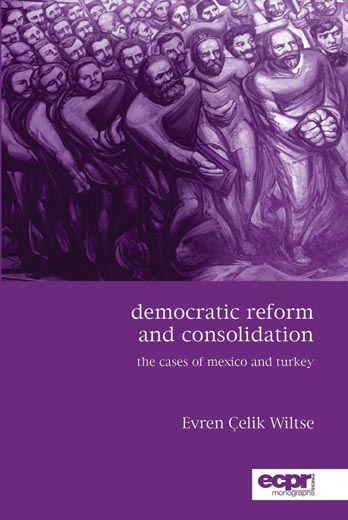
This is an important contribution to the literature on hybrid political regimes; those located between authoritarian systems and fully consolidated democracies. The book represents an illuminating account of how different forms of engagement with key external actors have succeeded in advancing the frontiers of democracy far better in Mexico than in Turkey over recent years. One of the book's central – but paradoxical – conclusions is that indirect conditionality through greater economic openness and societal interaction between Mexico and the United States has been more effective in promoting democracy in Mexico than the limited impact of direct EU conditionality in the Turkish context. -- Ziya Önis, Koç University
This wonderful book breaks new ground in cross-cultural comparison. Bridging language, cultural, and geographic boundaries, Çelik Wiltse compares two big, important countries bordering on even bigger economies. Both started modernising under traditional regimes, both had revolutions in the early twentieth century out of which emerged new development-oriented regimes, both pursued import substitution industrialisation, both are now liberalising, democratising, and globalising. Kudos to the author for undertaking this pioneering comparative work.
-- Howard J Wiarda, Center for Strategic and International Studies
Evren Çelik Wiltse is an Assistant Professor of Political Science at the South Dakota State University (SDSU). Before SDSU, she worked at the TOBB University of Economy & Technology in Ankara, Turkey. She received Bachelor's and Master's degrees from Bo?aziçi University in Istanbul. Her PhD is from the University of Massachusetts, Amherst. Her research is on political institutions, political economy, development and democratisation. Her works compare and contrast economic development and democracy in Latin America with the Middle East. Her article Globalization and Mexico is published in an edited volume on globalisation by the University Press of New England. Evren Çelik Wiltse contributes to policy-oriented discussions through policy papers published by think tanks (TEPAV) and popular academic journals, such as Economy and Society (?ktisat ve Toplum). Her articles were published in South European Society and Politics, and Perceptions. She was the guest editor of the Winter 2014 Special International Political Economy Issue of Perceptions.
The ECPR may receive a commission from the Amazon Services LLC Associates Program or the Google eBooks™ Affiliate Program for qualifying purchases made through the product links on our website.