Menu
Menu

Install this application on your home screen for quick and easy access when you’re on the go.
Just tap then “Add to Home Screen”
By Antonino Palumbo
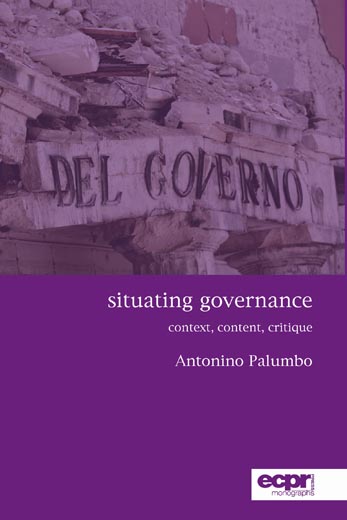
Antonino Palumbo engages in the rare undertaking of an explicitly normative investigation into concepts and practices of governance. Grounding his analysis in the political, Palumbo interrogates unwarranted claims for the superiority of “governance” over “government” and discloses the performativity of dominant governance heuristics, the regulatory state and networked polity. He prepares the ground for normative policy analysis, rejecting neoliberal centralisation and exploring grounds for a revitalised democratic culture. The book will be a rich and provocative resource for academics, graduate students, theory-minded activists and critical practitioners alike. -- Jonathan Davies, De Montfort University
The literature on governance has been expanding rapidly, and Nino Palumbo has provided both a good summary of the existing literature and a significant enhancement to that literature. His important book examines the content of the governance literature, but does so in historical and comparative context. The emphasis on context in understanding how governance functions, and the likelihood of success in governing, distinguishes this work from many more abstract presentations of the subject. In addition, his critiques of governance – as theory and practice – are cogent and well-considered.
-- B Guy Peters, University of Pittsburgh
Antonino Palumbo is a political theorist who has recently worked on globalisation, the transformation of governance and the implications of changes in state steering for modern representative democracies. He holds an MA in PPE and a PhD in Politics from the University of East Anglia. Since 2002 he has been lecturer in political philosophy at Palermo University (Italy). He is also Honorary Senior Research Associate in the Department of Political Science, School of Public Policy, University College London. His research interests are in analytical theories of the state, human rights and social justice; state, identity and democratic theory; neoliberalism, governance and applied ethics. His most recent works are: La Polity reticolare (XL Edizioni, 2011) and Globalizzazione e governance delle società multiculturali (co-edited with V. Segreto, Mimesis, 2011). He also is co-editor of Ashgate’s four-volume Library of Contemporary Essays in Political Theory and Public Policy.
The ECPR may receive a commission from the Amazon Services LLC Associates Program or the Google eBooks™ Affiliate Program for qualifying purchases made through the product links on our website.