Menu
Menu

Install this application on your home screen for quick and easy access when you’re on the go.
Just tap then “Add to Home Screen”
By Iain Hampsher-Monk
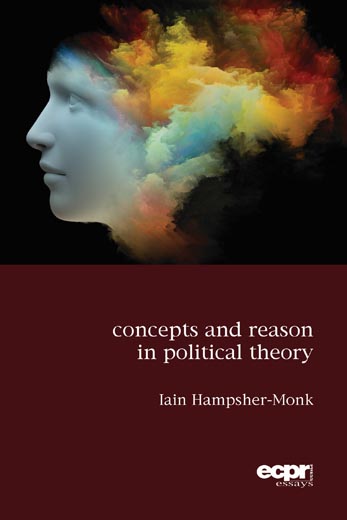
Accessible by specialists and non-specialists alike, Iain Hampsher-Monk’s essays illustrate the author’s broad intellectual profile, crossing borders between the history of political thought and other forms of political theorising; normative and interpretative forms of political theory; or political theory and political economy. Though he works mainly in the Anglophone tradition, Hampsher-Monk applies himself to continental styles of thinking and writing, such as the history of concepts. Rather than leave the study of political institutions to empiricists, he deals with them as subject of political theorising – a valuable point. -- Kari Palonen, University of Jyväskylä
Iain Hampsher-Monk is one of our leading historians of political thought. These remarkable essays display his range and erudition, and demonstrate why the study of political thought remains an essential basis for understanding politics.
Andrew Gamble, Queens’ College Cambridge -- Andrew Gamble, Queens’ College Cambridge
Iain Hampsher-Monk studied PPE (University of Keele) and with Bernard Crick at the University of Sheffield. He joined the University of Exeter in 1971, where he was appointed Professor of Political Theory in 1995, and head of department (1996-2000). He has held visiting posts in St Louis, the Netherlands, and Ljubljana. He was twice RAE panellist (2004, 2008); and convened the Political Thought Conference (UK) 2006-12) He founded (1980) with Janet Coleman the journal History of Political Thought which he still edits; is author of the PSA prizewinning History of Modern Political Thought (Blackwell, 1994); and has recently edited Burke’s Reflections on the Revolution in France (CUP). His substantive research includes over fifty articles and chapters on writers, concepts and issues in the history of political thought, together with an interest in the role played by rationality as an explanatory and interpretive concept in both historical and political science explanations.
The ECPR may receive a commission from the Amazon Services LLC Associates Program or the Google eBooks™ Affiliate Program for qualifying purchases made through the product links on our website.