Menu
Menu

Install this application on your home screen for quick and easy access when you’re on the go.
Just tap then “Add to Home Screen”
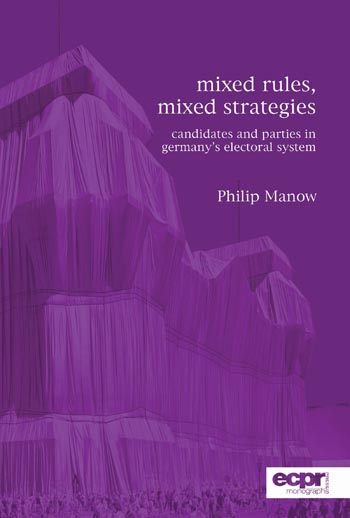
By Philip Manow
Professor Manow provides a terrific summary of the modern literature on Germany’s mixed electoral system and extends it in several directions. Highly recommended for scholars of mixed electoral systems. -- Jens Hainmueller, Stanford University
Professor Manow’s book establishes a new standard for work on German elections and on mixed-member proportional electoral systems more generally. Given the influence of the German system on electoral system designers around the world in the past quarter century, this book should rightly find a broad audience.
-- John M Carey, Dartmouth College
Philip Manow is professor of comparative political economy at Bremen University. Previously he held positions at the Max-Planck Institute for the Study of Societies, Cologne, and at Konstanz and Heidelberg Universities. He was a visiting scholar at Harvard’s Center for European Studies, at the Centre Études Européenne, Sciences Po Paris, and was fellow at the Wissenschaftskolleg zu Berlin. His research interests cover democratic theory, the German political system, comparative political economy and European integration. He has published in Legislative Studies Quarterly, European Journal of Political Research, Politics & Society, Comparative Political Studies, West European Politics and the British Journal of Political Science, among others.
The ECPR may receive a commission from the Amazon Services LLC Associates Program or the Google eBooks™ Affiliate Program for qualifying purchases made through the product links on our website.