ECPR

Install the app

Install this application on your home screen for quick and easy access when you’re on the go.

Just tap Share then “Add to Home Screen”

ISBN:
9781785522543 9781786605306 9781786613110
Type:
Hardback
ePub
Paperback
Publication Date: 1 May 2018
Page Extent: 258
Series: Studies in European Political Science
Buy Hardback from AmazonBuy EPUB from GoogleBuy Paperback from Amazon

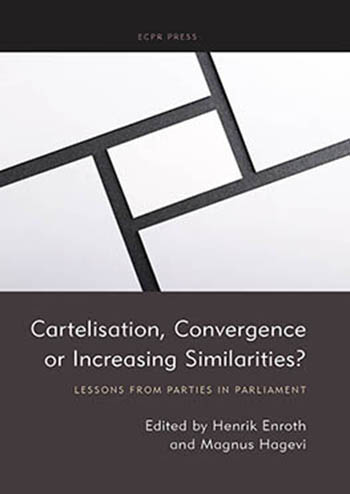
Cartelisation, Convergence or Increasing Similarities?

Lessons from Parties in Parliament

By Henrik Enroth, Magnus Hagevi

It is often suggested that political parties are becoming increasingly alike, and that party politics has turned into an elite affair where political professionals collude to further their self-interest rather than work to represent the interests of their constituents. In recent decades this diagnosis has been famously associated with Richard Katz and Peter Mair's cartel party theory. Yet so far this controversial thesis has not been subjected to systematic empirical scrutiny, nor has its conceptual and normative underpinnings been properly considered.

In this volume a group of political scientists with different specialisations take on this task, focusing empirically on the Swedish party system, which the originators of the cartel party theory have suggested is especially conducive to the formation of party cartels. Collecting new and unique qualitative and quantitative data, the volume casts serious doubt on the validity of the cartel party theory as an explanation for party system change.

The cartel thesis has been remarkably influential. In over two decades, reference to it has been almost obligatory in published research on party politics. Enroth and Hagevi's excellent anthology unpacks the thesis and subjects it to thorough and rare empirical tests. The admirably clear conclusions about representative democracy in a crucial case - Sweden - leave party scholars with much to ponder. -- Nicholas Aylott, Södertörn University

A forceful attack on the cartel party theory. The authors make efficient use of their Swedish case study for questioning many of the core assumptions and normative judgements of the most influential account in contemporary party research -- Klaus Detterbeck, University of Göttingen

Henrik Enroth is Associate Professor at Linnaeus University, with a broad interest in social and political theory. Recently his work has appeared in journals such as Party Politics, International Political Sociology, European Journal of Social Theory, and Contemporary Political Theory.


Magnus Hagevi is Professor in political science and the leader of Surveyinstitutet at Linnaeus University, Sweden, with a special interest in political parties and political behaviour at mass and elite levels.

The ECPR may receive a commission from the Amazon Services LLC Associates Program or the Google eBooks™ Affiliate Program for qualifying purchases made through the product links on our website.