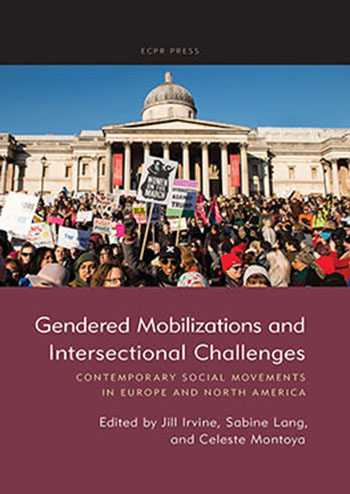
A long and ongoing challenge for social justice movements has been how to address difference. Traditional strategies have often emphasized universalizing messages and common identities as means of facilitating collective action. Feminist movements, gay liberation movements, racial justice movements, and even labour movements, have all focused predominantly on respective singular dimensions of oppression. Each has called on diverse groups of people to mobilize, but without necessarily acknowledging or grappling with other relevant dimensions of identity and oppression.
While focusing on commonality can be an effective means of mobilization, universalist messages can also obscure difference and can serve to exclude and marginalize groups in already precarious positions. Scholars and activists, particularly those located at the intersection of these movements, have long advocated for more inclusive approaches that acknowledge the significance and complexity of different social locations, with mixed success. Gendered Mobilizations and Intersectional Challenges provides a much-needed intersectional analysis of social movements in Europe and North America. With an emphasis on gendered mobilization, it looks at movements traditionally understood and/or classified as singularly gendered as well as those organized around other dimensions of identity and oppression or at the intersection of multiple dimensions.
This book importantly enhances existing scholarship on gendered movements. It does so by jointly studying feminist and women's movements with mobilizations that are gendered but have another dominant focus (on race or sexuality), or that act at the intersections. It also presents a much needed theoretical and methodological framework for applying intersectionality theory to the study of social movements. -- Karen Celis, Vrije Universiteit Brussel
This is an impressive interdisciplinary work on "social movement intersectionality" by an international group of scholars. Cutting edge-theories, methods and concepts are developed and used to study gender-based and social justice movements. The framing introduction and the quality case analyses in North America and Europe provide an unprecedented study that contributes to understanding and theories of intersectionality in movement AND the application of intersectional approaches in research. -- Amy G. Mazur, Washington State University
How to forge a politics of solidarity without suppressing difference is one of the urgent questions this wonderful collection addresses. In examining the opportunities and obstacles for intersectionality in social movements in a range of national, transnational and political contexts, this volume rigorously extends an intersectional analysis grounded in empirical evidence and praxis. Essential reading for scholars and activists alike. -- Fiona Williams, University of Leeds
After long debates about intersectionality and transversal politics, this is an important and timely book. It represents forms of inclusive feminist activism in the face of exclusionary intersectional policies by right-wing populist actors and critically weighs the potential of these social justice movements. The comparative country focus and the systematic perspective on gendered social justice movements makes the volume a fundamentally important contribution to understanding current feminist movements as well as counter-movements against right-wing politics. -- Birgit Sauer,University of Vienna
Theorizing intersectionality as a social movement ethic and political practice as well as a research paradigm, this impressive collection illuminates dimensions of power obscured in mainstream political science and addresses persistent dilemmas that haunt efforts to recognize complex vectors of marginalization while attempting to mobilize coalitions for progressive political transformation. -- Mary Hawkesworth, Rutgers University
What does intersectionality look like in practice? By merging social movement and intersectionality theories the authors expose the intricate ways in which power functions across a myriad of identities and spaces in a beautiful and poignant way that exposes the cracks and solidarity of organizing across difference. This work exquisitely pushes the boundaries of intersectionality. -- Julia Jordan-Zachery, University of North Carolina at Charlotte
Jill Irvine is Presidential Professor of Women's and Gender Studies at the University of Oklahoma. She is founding director and currently co-director of the OU Center for Social Justice. Irvine received her Ph.D. in Government from Harvard University. Her teaching and research interests include social movements, political mobilization, and transnational activism, with a focus on gender. She has written numerous books, articles, chapters and government reports on ethno-religious movements and democratic transformations in Eastern Europe. Her work has been supported among other funding agencies by the National Science Foundation, the American Council of Learned Societies, The Fulbright Scholar Program, the National Council for Eurasian and East European Research, and the International Research and Exchanges Board.
Sabine Lang is Associate Professor of International and European Studies at the Henry M. Jackson School of International Studies of the University of Washington. She is Director of the Center for West European Studies at UW. She received her Ph.D. in Political Science from the Free University in Berlin and has held previous teaching positions at the University of Leipzig and at the J. F. Kennedy-Institute of the Free University Berlin, Germany. Her areas of research are gender politics and comparative politics with an emphasis on NGOs and coalition building among transnational movements. Her latest book NGOs, Civil Society, and the Public Sphere was published by Cambridge University Press in 2013 and she contributes to journals such as Femina Politica, European Journal for Women's Issues, Publius, and German Politics.
Celeste Montoya is Associate Professor of Women and Gender Studies at the University of Colorado Boulder. She is Director of the Miramontes Arts & Science Program. Montoya received her Ph.D. in Political Science at Washington University, St. Louis. Her teaching and research interests focus on the politics of marginalized groups, with an emphasis on intersectionality. She studies social movements, institutions, and policies in the United States and Europe, in both domestic and transnational context. She is author of From Global to Grassroots (Oxford University Press) and has published in such journals as International Organizations, Politics & Gender, Social Politics, Publius, and Urban Affairs Review.
Petra Ahrens is Senior Researcher at the Faculty of Social Sciences, Tampere University, Finland. Her research focuses on gender politics in the European Union, and social politics in Germany. She also provides expertise as a policy consultant on gender equality policy for German public administration. She is the author of Actors, Institutions, and the Making of EU Gender Equality Programmes. (Palgrave Macmillan, forthcoming October 2017). She has published book chapters as well as articles and she is co-editor of the German journal "Femina Politica".
Phillip M. Ayoub is Associate Professor of Diplomacy and World Affairs at Occidental College. His research bridges insights from international relations and comparative politics, engaging with literature on transnational politics, sexuality and politics, norm diffusion, and social movements. Alongside several articles, he is the author of When States Come Out: Europe’s Sexual Minorities and the Politics of Visibility (2016) and co-editor, with David Paternotte, of LGBT Activism and the Making of Europe (2014).
Jean Beaman is Assistant Professor of Sociology and affiliate faculty of African-American Studies, Global Studies, and American Studies at Purdue University. Her research focuses on race/ethnicity, racism, immigration, and state-sponsored violence in both the United States and France. She is the author of Citizen Outsider: Children of North African Immigrants in France (2017).
Nadia E. Brown (PhD, Rutgers University) is University Scholar and Associate Professor of Political Science and African American Studies at Purdue University. Her research interests lie broadly in identity politics, legislative studies, and black women’s studies. She is the author of the award-winning book Sisters in the Statehouse: Black Women and Legislative Decision Making (2014) and coeditor, with Sarah Allen Gershon, of Distinct Identities: Minority Women in U.S. Politics (2016).
Rachel H. Brown is Assistant Professor of Women, Gender, & Sexuality Studies at Washington University in St. Louis. Her areas of scholarship include feminist political theory, carework and reproductive labour, migration, and citizenship and settler colonial studies. Brown’s current book project is entitled Four Years, Three Months: Migrant Caregivers in Palestine/Israel. Brown received her PhD in political theory from The Graduate Center, City University of New York.
Pauline Cullen is Lecturer in Sociology and Politics in the Department of Sociology, Maynooth University, National University of Ireland. Her research examines civil society mobilization on social justice and gender equality at national and European Union level, women’s movements, and gender and political representation. This work has been published in the Journal of Civil Society, Social Movement Studies, Gender Work and Organization, and Politics & Gender.
Nicole Doerr is Associate Professor of Sociology at the University of Copenhagen. Her research investigates how and under what conditions increased linguistic and cultural diversity fosters democratic innovation in social movements, local democracy, and participation by migrants, refugees, and minorities. She is the author of Political Translation—How Social Movement Democracies Survive (2018) and coeditor, with Alice Mattoni and Simon Teune, of Advancing the Visual Analysis of Social Movements (2013).
Ayşe Dursun (PhD, University of Vienna) is a postdoctoral researcher at the University of Vienna, Department of Political Science. Her research areas include gender, women’s movements, intersectionality, gender equality policies, and migration. She is the author of Muslim Groups in the Gezi Park Protests: Identity Politics and Contentious Politics under Authoritarian
Neoliberalism in Contentious Politics in the Middle East, edited by Fawaz Gerges (2015).
Andrea Krizsán is Research Fellow at the Center for Policy Studies, Central European University, Budapest. Her research focuses on understanding equality policy change in countries of Central and Eastern Europe. Her current research is on the politics of policy backsliding in times of crisis and forms of feminist resistance to such reversal. She is coauthor with Conny Roggeband of The Gender Politics of Domestic Violence: Feminist Engaging the State in Central and Eastern Europe (2018) and coeditor, with Judith Squires and Hege Skjeie, of Instituting Intersectionality: The Changing Nature of European Equality Regimes (2012).
Raluca Maria Popa is a PhD candidate in comparative gender studies at the Central European University. She is a gender specialist at the International Development Law Organization (IDLO). In addition to the work in her dissertation on State Feminism within State Socialism: Rethinking Communist Women’s Activism in Romania, 1944–1989, she has published several book chapters and articles on gender violence.
Andrea Spehar is Associate Professor in political science and director of the Centre on Global Migration (CGM) at the University of Gothenburg, Sweden. Her fields of interest comprise migration and gender policy development in Europe. Her work has appeared, among others, in the Journal of European Public Policy, Comparative European Politics, Journal of Women, Politics & Policy, Eastern European Politics & Societies, and the International Feminist Journal of Politics.
Leda Sutlović is a PhD candidate and an external lecturer at the Department of Political Science, University of Vienna. She holds an MA from the Central European University and a degree from University of Zagreb in Political Science. Her thesis project focuses on (post)socialist transformations of Croatian gender policies, bringing together the approach of discursive and historical
institutionalism with the role of knowledge and ideas in politics.
Fernando Tormos-Aponte (PhD, Purdue University) is a postdoctoral fellow with the Scholars Strategy Network and a research fellow of the Southern Methodist University Latino Center for Leadership Development. He specializes in social movements, identity politics, social policy, and transnational politics. His work has appeared in Politics, Groups, and Identities, Environmental Policy and Governance, and in the edited volume The Legacy of Second-Wave Feminism in American Politics.
Ethel Tungohan is Assistant Professor in the Department of Politics at York University and a Canada Research Chair (Tier 2) in Canadian Migration Policy, Impacts, and Activism. Her research uses socially engaged research methodologies to examine migrant social movements and immigration policy, focusing specifically on temporary labour migration. Her work has been published in various academic journals and edited books. She is also the coeditor of Filipinos in Canada: Disturbing Invisibility (2012).