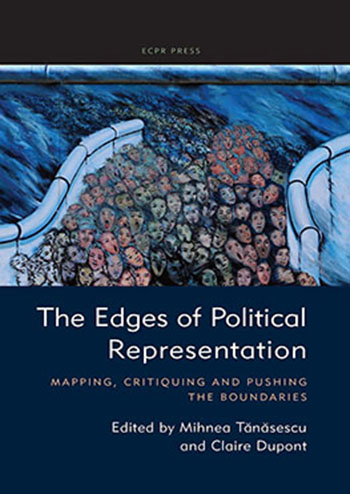
The concept of political representation has expanded beyond the classical relationship between representative and the represented to encompass advocacy, group identities, non-human voices, future generations, non-democratic systems, symbols, virtual representation and broader interests. As such, literature on political representation stems from a wide range of viewpoints and scholarly traditions, with different norms and assumptions built in.
This volume aims to map and critique the 'edges' of political representation. By moving from a discussion in the classical electoral literature through feminist perspectives to different levels of representation, different understandings of who is represented and onto empirical studies of symbolic and virtual representation through participation, the contributions in this book provide a nuanced assessment while also presenting future avenues for research that go beyond the mainstream of research on political representation. Taken together, the chapters provide a wide vista of political representation across several sub-disciplines in political science (political theory, political philosophy, party politics, electoral politics, feminism, European politics, minority politics, online governance etc.), and also open up new research avenues through a thorough investigation and critique of political representation in scholarship.
New ideas, practices and sites of political representation are challenging orthodox thinking in political science and in day-to-day politics. Featuring an impressive range of approaches and methods, the contributors to The Edges of Political Representation describe and interrogate these challenges--electoral, symbolic, transnational and generational among others. The book is a timely and sophisticated series of takes on the new frontiers of representation. -- Michael Saward, University of Warwick
This collection is a timely and challenging contribution to thinking about representative democracy. The problem of incomplete representation is tackled throughout: however free and fair elections may be, they do not imply an equal and fair inclusion of intra-societal differences. This makes the book a must-read for all those who care for a just democracy. -- Hans Keman, Vrije Universiteit Amsterdam
Claire Dupont is a postdoctoral research fellow at the Institute for European Studies and the Political Science department, Vrije Universiteit Brussel. Her main research focus is on the climate and energy policies of the European Union, and on how the democratic decision---making procedure in place in the EU can tackle the complex problem of climate change.
Mihnea Tănăsescu is an FWO Postdoctoral Research Fellow at the Political Science Department, Vrije Universiteit in Brussels. Mihnea's research focuses on the meaning of representation in relation to the concept of rights, particularly when applied to non-human entities or beings.
Ilke Adam is research professor at the Institute for European Studies (IES) of the Vrije Universiteit Brussel (main affiliation) and a part-time lecturer at the Université Libre de Bruxelles. She coordinates the Migration, Diversity and Justice research cluster at IES. Her research interests include immigration and immigrant integration policies, multiculturalism, citizenship, discrimination,
sub-state nationalism and comparative public policy.
Soumia Akachar received her PhD in political sciences from Vrije Universiteit Brussel (VUB). Her research focused on the political representation of Muslim youth in Flanders and their feelings of (not) being politically represented. This research was facilitated by the research programme Evaluating Democratic Governance in Europe. She is also a member of RHEA, the VUB Centre of Expertise Gender, Diversity and Intersectionality. Prior to that, Soumia obtained a master’s in sociology and political sciences from the University of Amsterdam. Soumia is currently affiliated with the Sociology Department at the Free University of Amsterdam.
Karen Celis is research professor at the Department of Political Science of the Vrije Universiteit Brussel, and affiliated to RHEA (Centre for Gender and Diversity). She conducts theoretical and empirical research (qualitative, comparative) on political representation of groups (women, ethnic minorities, class, age groups, LGBT), equality policies and state feminism. She is co-editor of theThe Oxford Handbook on Gender and Politics (OUP, 2013, with Georgina Waylen, Johanna Kantola and Laurel Weldon).
Serena D’Agostino is a postdoctoral researcher at the Institute for European Studies (IES) and the Department of Political Science of the Vrije Universiteit Brussel (VUB). She coordinates the joint research programme Evaluating Democratic Governance in Europe (EDGE), together with Ferran Davesa, and is a member of the IES research cluster on Migration, Diversity and Justice. Serena is also a member of the VUB RHEA Centre of Expertise on Gender, Diversity & Intersectionality and an associate member of the European Academic Network on Romani Studies. She has worked in the International Development Co-operation sector in the Western Balkans and coordinated humanitarian aid interventions in Eastern Africa. Her research interests include Central Eastern Europe, Europeanization, intersectional mobilization, (political) intersectionality, migration and minorities, Roma activism, Roma women, and social movements.
Ferran Davesa is a postdoctoral researcher at the Institute for European Studies (IES) at the Vrije Universiteit Brussel (VUB). He coordinates the joint research programme Evaluating Democratic Governance in Europe (EDGE), together with Serena D’Agostino. He is part of the research project All Youth Want to Rule Their World (ALL-YOUTH), funded by the Strategic
Research Council at the Academy of Finland (decision no. 312689). From 2008 to 2013, Davesa was a researcher of the Comparative Agendas Project (CAP) at the Institut Barcelona d’Estudis Internacionals (IBEI) and at the University of Barcelona (UB). His research interests include political participation, social movements, interest groups and youth policy, with special focus on the impact of new technologies and new media.
Kris Deschouwer is Emeritus Professor of Politics at Vrije Universiteit Brussel. His research focuses on political parties, elections, regionalism and federalism, democracy in divided societies, and political representation. He is the central coordinator of the PartiRep research project on Political Participation and Representation in Modern Democracies, http://www.PARTIREP.eu. Kris was co-editor of the European Journal of Political Research (2003–2009) and authored The Politics of Belgium (Palgrave, 2012). He was ECPR Chair, 2018–2021.
Sebastian Oberthür is professor for environment and sustainable development at the Institute for European Studies (IES) at the Vrije Universiteit Brussel (VUB). Trained as a political scientist with a strong background in international law, he is an internationally renowned expert on international and European environmental and climate governance.
Eline Severs is assistant professor in political science at the Vrije Universiteit Brussel (VUB). Her research interests fall within the field of democratic theory. She is especially interested in democratic representation, the relationships between civil society and democratic governance, representation fairness, and citizens’ understandings of (representative) democracy. She has
published various articles and book chapters on these topics. She recently edited, together with Suzanne Dovi (University of Arizona), a symposium on ‘The Good Representative 2.0’ in PS: Political Science and Politics (2018).
Jamal Shahin is a part-time research professor at the Institute for European Studies (Vrije Universiteit Brussel) and part-time senior lecturer at the University of Amsterdam. He holds a PhD in politics from the University of Hull (2004). In Amsterdam, he lectures on the BA and MA programmes in European studies. His courses concern the governance of the contemporary EU and the importance of linking theory and practice to inform better research and policy. His research interests focus on global Internet governance, political participation in the European Union, EU governance, and the impact of the internet on policymaking. Jamal is keen to explore how new forms of social and political organization at the global and European levels influence the effectiveness and legitimacy of decision-making. Jamal is also very interested in the relationship between science and society and has carried out research on how to optimize dialogue between disciplines to ensure that relevant and useful research can help critique, design and improve policy.