Menu
Menu

Install this application on your home screen for quick and easy access when you’re on the go.
Just tap then “Add to Home Screen”
By Michael Koß
Michael Koß has written a highly interesting and, despite all historical meticulousness oppressively timely book. -- Florian Meinel, Frankfurter Allgemeine Zeitung
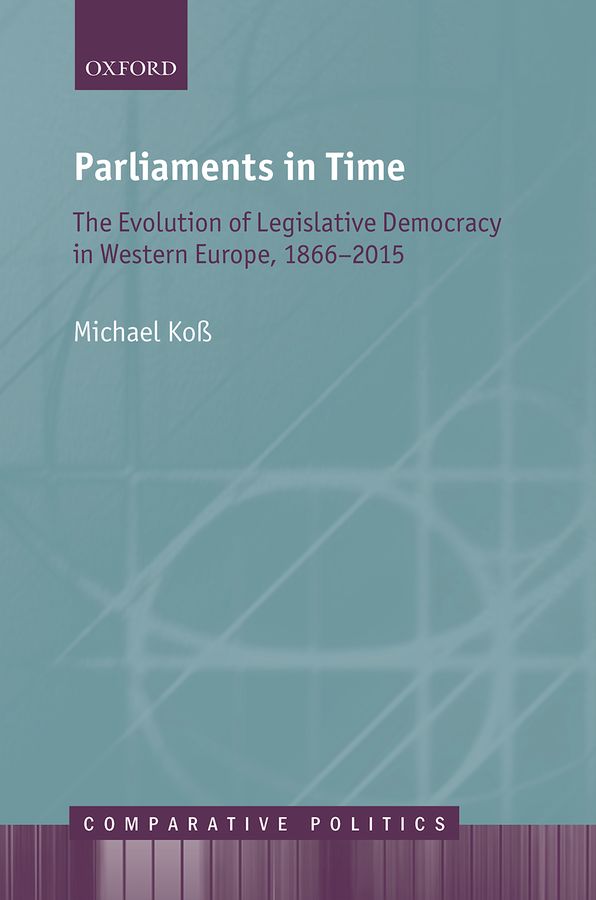
Why has legislative democracy sometimes led to centralized, and sometimes to decentralized, committee-based parliaments? Broad in scope, bold in its claim, sophisticated in its theoretical argument, elegant in its exposition, meticulous in its historical process-tracing - Michael Koß has written a brilliant book that provides a novel, persuasive answer to an essential question. -- Philip Manow, University of Bremen
Michael Koß has pulled off a truly impressive feat: with historical depth, theoretical incisiveness, and awesome empirical scrupulousness, he gives us a new portrayal of the emergence of Europe's democracies. Through a careful and powerfully comparative telling of the institutional evolution of Europe's parliaments, we emerge with new appreciation for the details of how parliaments organize themselves. Legislative rules matter not only for legislatures but also for democracy itself. -- Daniel Ziblatt, Harvard University
Michael Koß is Professor of Comparative Politics at the Geschwister-Scholl-Institute of Political Science, Ludwig-Maximilians-University Munich. His publications include The Politics of Party Funding (OUP, 2011), Left Parties in National Governments (co-edited with Jonathan Olsen and Dan Hough, Palgrave, 2010), and The Left Party in Contemporary German Politics (co-authored wtih Dan Hough and Jonathan Olsen, Palgrave, 2007).
The ECPR may receive a commission from the Amazon Services LLC Associates Program or the Google eBooks™ Affiliate Program for qualifying purchases made through the product links on our website.