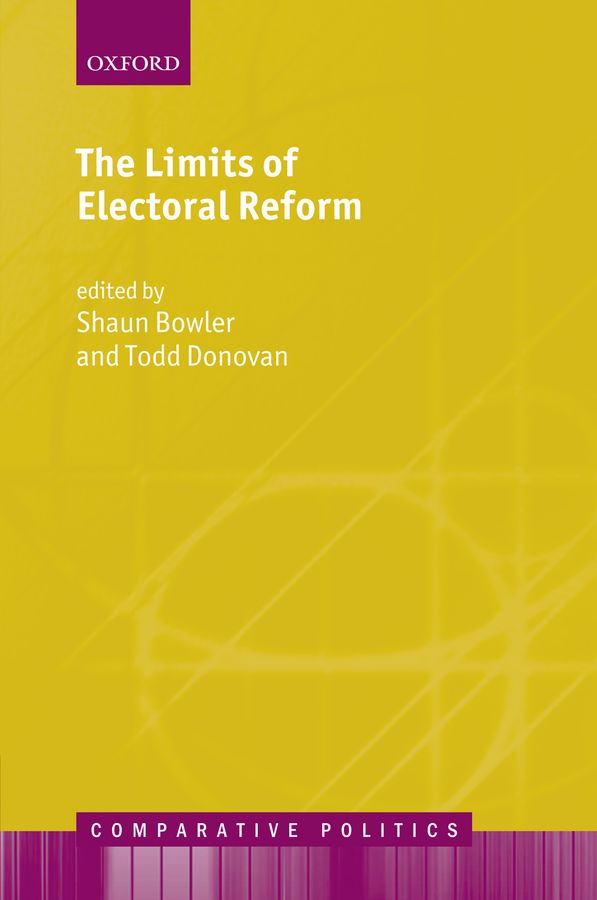
Institutions 'matter' to electoral reform advocates and political scientists - both argue that variation in electoral institutions affect how elected officials and citizens behave. Change the rules, and citizen engagement with politics can be renewed. Yet a look at the record of electoral reform reveals a string of disappointments. This book examines a variety of reforms, including campaign finance, direct democracy, legislative term limits, and changes to the electoral system itself. This study finds electoral reforms have limited, and in many cases, no effects. Despite reform advocates' claims, and contrary to the 'institutions matter' literature, findings here suggest there are hard limits to effects of electoral reform. The explanations for this are threefold. The first is political. Reformers exaggerate claims about transformative effects of new electoral rules, yet their goal may simply be to maximize their partisan advantage. The second is empirical. Cross-sectional comparative research demonstrates that variation in electoral institutions corresponds with different patterns of political attitudes and behaviour. But this method cannot assess what happens when rules are changed. Using examples from the US, UK, New Zealand, Australia, and elsewhere this book examines attitudes and behaviour across time where rules were changed. Results do not match expectations from the institutional literature. Third is a point of logic. There is an inflated sense of the effects of institutions generally, and of electoral institutions in particular. Given the larger social and economic forces at play, it is unrealistic to expect that changes in electoral arrangements will have substantial effects on political engagement or on how people view politics and politicians. Institutional reform is an almost constant part of the political agenda in democratic societies. Someone, somewhere, always has a proposal not just to change the workings of the system but to reform it. The book is about how and why such reforms disappoint.
30% off all books in the Comparative Politics Series for ECPR Member affiliates – please contact editorial@ecpr.eu for more details on how to claim the discount.
Shaun Bowler received his Ph.D from Washington University, St. Louis and joined the UCR faculty in 1989. Professor Bowler's research interests include comparative electoral systems and voting behaviour. His work examines the relationship between institutional arrangements and voter choice in a variety of settings ranging from the Republic of Ireland to California's initiative process. Professor Bowler is the author of Demanding Choices: Opinion Voting and Direct Democracy with Todd Donovan, University of Michigan Press (1998). He is Professor in the Department of Political Science at the University of California, Riverside.
Todd Donovan's research examines representation and election systems, political behaviour, electoral politics, public opinion, and direct democracy. He is co-author of several books, including Electoral Reform and Minority Representation (with S. Bowler and D. Brockington), Ohio State University Press (2003); and Reforming the Republic (with Bowler), Prentice Hall (2004). He is a Professor of Political Science at Western Washington University, in Bellingham, where he has taught for more than 20 years.