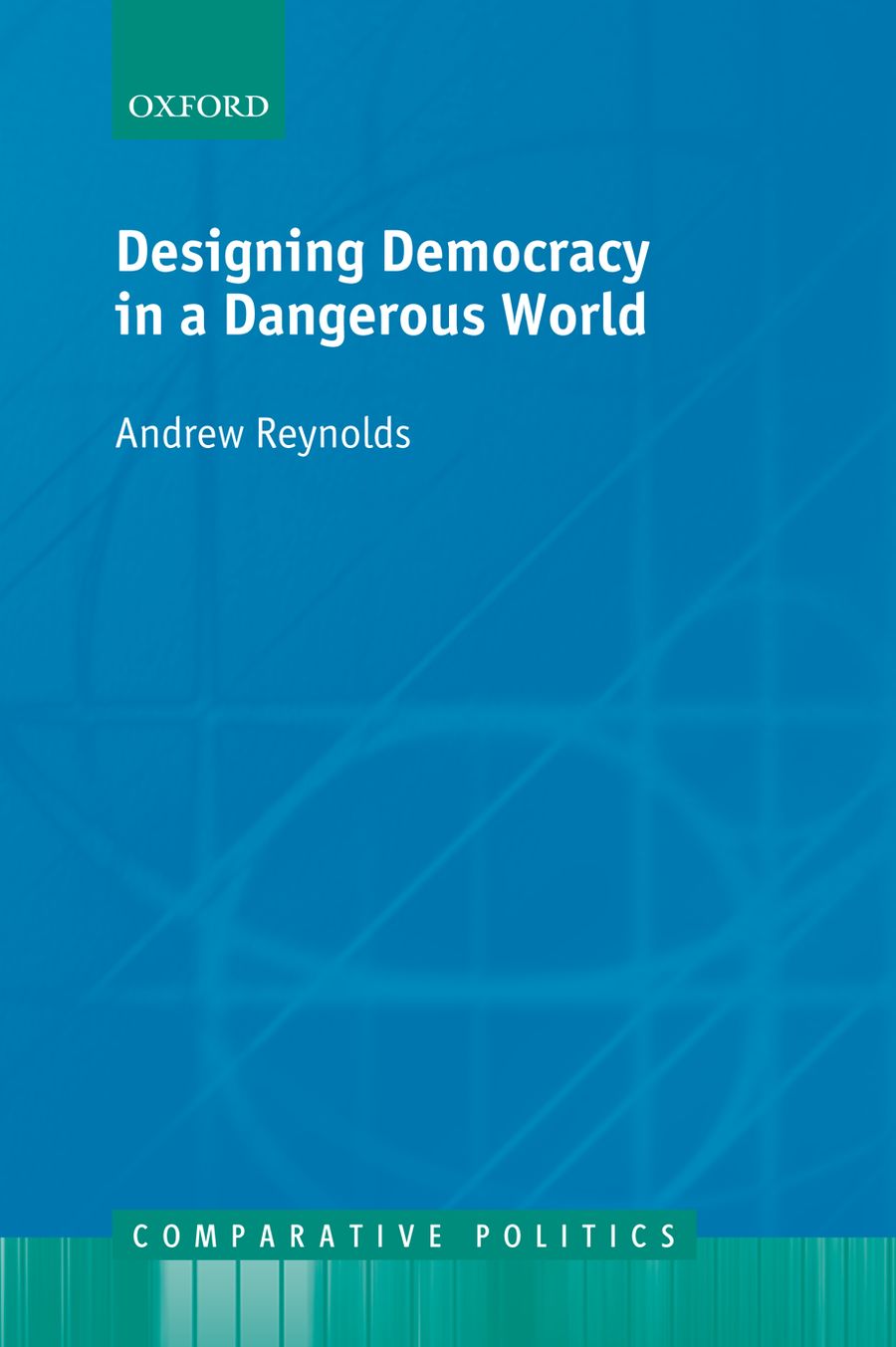
Designing Democracy in a Dangerous World addresses a question at the heart of contemporary global politics: how does one craft democracy in fragile and divided states? In Iraq and Afghanistan, spiraling conflict was driven in large part by the mistakes of institutional design in the immediate post-conflict period. The future hopes for peace and stability in those, and other cases, rest on a well designed political system which can bring legitimacy to elected leaders and offer reassurances to minorities.
This book fills gaps in knowledge in three ways. First, it develops a theoretical framework for assessing what type of democracy will best serve a nation. Second, it offers a behind the scenes look at the intricacies of democratic design in a number of focus cases. Third, the book pulls together lessons for policymakers by surveying patterns of success and failure over the last forty years. Reynolds tests his framework by drawing on extensive quantitative and qualitative evidence, gathering data from 66 cases to analyze the relationship between democracy and stability and a nation's demographic, socio-political, historical, and economic features, and previous levels of instability. To this mix are added institutional variables: electoral systems, decentralization, levels of executive inclusion, and executive type. For a qualitative focus the book draws on the author's experience as a constitutional adviser during the last fifteen years in democratizing nations such as South Africa, Afghanistan, Sierra Leone, Burma, Lebanon, Sudan, and Iraq.
There are very few places in the world today where the majority of people do not desire some degree of choice, accountability over their leaders, and the rule of law. The key is to craft a democracy that is home grown and appropriate to a given society. By bringing new evidence and arguments to bear on the topic of promoting democracy, Designing Democracy contributes to both foreign policy and academic debates.
30% off all books in the Comparative Politics Series for ECPR Member affiliates – please contact editorial@ecpr.eu for more details on how to claim the discount.
Andrew Reynolds is Chair of the Global Studies curriculum and Professor of Political Science at the University of North Carolina, Chapel Hill. He received his M.A. from the University of Cape Town and his Ph.D. from the University of California, San Diego. His research and teaching focus on democratization, constitutional design, and electoral politics. He has worked for the United Nations, the International Institute for Democracy and Electoral Assistance, the UK Department for International Development, the US State Department, the National Democratic Institute, the International Republican Institute, the Organization for Security and Cooperation in Europe and the International Foundation for Election Systems. He has also served as a consultant on issues of electoral and constitutional design for Afghanistan, Angola, Burma, Fiji, Guyana, Indonesia, Iraq, Jordan, Kenya, Liberia, Netherlands, Netherlands Antilles, Northern Ireland, Sierra Leone, South Africa, Yemen, Zimbabwe, and Kabul.