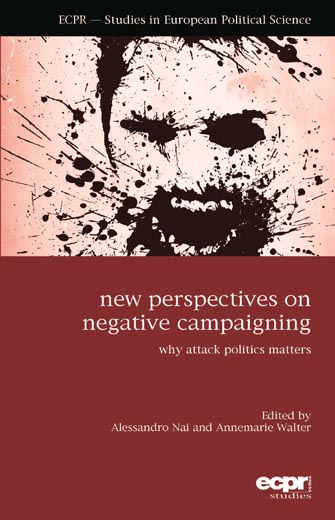
Have you ever seen a politician fiercely attacking his opponent? Sure you have. Election campaigns without attacks on the rival candidate's performance, policy propositions and traits simply do not exist.
Negative campaigning makes up a substantial part of election campaigns around the world. Though heavily covered in election news, the practice is strongly disliked by political pundits, journalists and voters. Some are even concerned that negative campaigning damages democracy itself.
Negative campaigning has inspired numerous scholars in recent decades. But much of the existing research examines the phenomenon only in the United States, and scholars disagree on how the practice should be defined and measured, which has resulted in open-ended conclusions about its causes and effects.
This unique volume presents for the first time work examining negative campaigning in the US, Europe and beyond. It presents systematic literature overviews and new work that touches upon three fundamental questions: What is negative campaigning and can we measure it? What causes negative campaigning? And what are its effects?
Barbara Allen is Ada M. Harrison Distinguished Teaching Professor of the Social Sciences, Professor and former chair of the Department of Political Science, Carleton and former Director of Women’s Studies at Carleton College, Northfield, MN (United States) as well as Senior Research Fellow of the Vincent and Elinor Ostrom Workshop in Political Theory and Policy Analysis at Indiana University (United States). She has received fellowships for various projects including her book, Tocqueville, Covenant, and the Democratic Revolution, from the Bush Foundation, the National Endowment for the Humanities and the Earhart
Foundation. She has published a number of articles on election campaign news coverage and political advertising and was awarded the American Political Science Association Rowman and Littlefield Innovations in Teaching Award in 2005. She
has received fellowships for various projects from the Bush Foundation and the National Endowment for the Humanities and the Earhart Foundation. In addition to studies of political communication, she has conducted community-based participatory research on topics of concern to Deaf Americans. Most recently she directed the award-winning feature length documentary, Signing On: Stories of Deaf Breast Cancer Survivors, their Families and Community.
William L Benoit is a Professor of Communication Studies at Ohio University (United States). He developed the Functional Theory of Political Campaign Communication. He has published articles and books on political TV spots and debates from election campaigns in the United States and other countries. His most recent books, published in 2014, are A Functional Analysis of Presidential Television Advertisements (2nd edition, Lexington Books) and Political Election Debates: Informing Voters About Policy and Character (Lexington Books).
Laurent Bernhard is a postdoctoral researcher at the University of Zurich. His PhD thesis focused on the campaign strategies adopted by political actors in the context of direct-democratic campaigns. Together with Marco Steenbergen (University of Zurich) and Hanspeter Kriesi (EUI, Florence), he currently leads a project that deals with populism in Western Europe in the framework of the research programme NCCR Democracy.
André Blais, Université de Montréal
Marian Bohl is a PhD candidate at University of Zurich (Switzerland). After undergraduate studies at the University of Mannheim and Johns Hopkins University, he joined the ‘Making Electoral Democracy Work’ project at University of Zurich. His research interests are election campaigning as well as regional and national electoral behaviour.
Damien Bol is a postdoctoral fellow at the Canadian Research Chair in Electoral Studies of the University of Montreal (Canada). He received his PhD from the University of Louvain in 2013. His research fields are comparative politics and political methodology. He is particularly interested in comparative political institutions and political behaviour. His work appears in the European Journal of Political Research, West European Politics, Party Politics, and Political Research Quarterly (among other journals).
Felipe Borba is a professor in the department of political science at the Federal University of The State of Rio de Janeiro and a postdoctoral researcher at State University of Rio de Janeiro (Brazil). His research interests are Brazilian politics, electoral behaviour, political communication, public opinion, and electoral campaign. Felipe Borba is also a political consultant and works for different candidates and parties in Brazil.
Wouter de Nooy is Associate Professor in the Department of Communication Science at the University of Amsterdam (The Netherlands) and a member of the Amsterdam School of Communication Research ASCoR. His research interests
include political communication and social network analysis.
Martin Dolezal is a post-doctoral researcher for the Austrian National Election Study (AUTNES) and Assistant Professor (Universitätsassistent) at the Department of Government, University of Vienna (Austria). Dolezal has published on various aspects of party competition, electoral behaviour, and ‘unconventional’ modes of political participation. He is, amongst others, co-author of West European Politics in the Age of Globalization (2008) and Political Conflict in Western Europe (2012).
Laurenz Ennser-Jedenastik is a postdoctoral researcher at the University of Vienna’s Department of Government (Austria) with a research interest in political parties, coalition politics, patronage, and politicisation in the public sector. He is the author of a number of publications, including articles in the European Journal of Political Research, West European Politics, Party Politics,
Political Studies, and Governance.
François Gélineau holds the Research Chair in Democracy and Parliamentary Institutions at Université Laval (Canada). He is Associate Professor of Political Science. His research and teaching interests include the study of elections and electoral behaviour in a comparative perspective. His work has been published in some of the best journals of the discipline, such as the British Journal of Political Science, Political Research Quarterly, Electoral Studies, the Journal of Elections, Public Opinion and Parties, and Publius.
Valentina Holecz is completing her Master Degree in Political Science at the University of Geneva (Switzerland). She joined the SNFS research project ‘Offensive Discourse in Political Arenas’ in 2014. Her present research interests are questions about political behaviour, feminist theory and the use of torture in democracy.
Jan Kleinnijenhuis is professor of Communication Science at the VU University Amsterdam (Vrije Universiteit Amsterdam) (The Netherlands). He received his PhD in 1990 at the Political Science Department of VU University Amsterdam. His research interests include the selection and content of political and economic news, and the effects of news on citizens and stakeholders.
Richard R Lau is Distinguished Professor of Political Science and Director of the Center for the Experimental Study of Politics and Psychology at Rutgers University (United States). His research focuses on information processing, political advertising, and voter decision-making. Recent books include Negative Campaigning: An Analysis of U.S. Senate Elections (with Gerry Pomper, Rowman
Littlefield, 2004) and How Voters Decide: Information Processing During Election Campaigns (with David Redlawsk, Cambridge, 2006).
Jürgen Maier is Professor of Political Communication at the University of Koblenz-Landau (Germany). His research focuses on media coverage of politics and its effects, political attitudes, electoral behaviour, and on quantitative methods. Within these fields he is specialised on televised debates, political scandals, experimental designs, and real-time response measurement.
Mario Marchesini is studying for an MA in political science at the University of Geneva, where he also completed his undergraduate studies. He joined the research project 'Offensive Discourse in Political Arenas: Forms, Causes, and Effects of Negativism in Politics', in 2014.
Wolfgang C Müller is Professor of Democratic Governance at the University of Vienna (Austria). Previous appointments included Chair and Director of the Mannheim Centre for European Social Research (MZES) at the University of Mannheim. He is currently Speaker and Principal Investigator of the Austrian National Election Study (AUTNES). Since 2013 he has been co-editor of West European Politics. His research interests include government coalitions, political parties and political institutions.
Adrien Petitpas is an undergraduate student at the University of Geneva (Switzerland). He joined the SNFS research project ‘Offensive Discourse in Political Arenas’ in 2014 and he is currently working on a meta-analysis on the individual effects of negative campaigning. His present research interests are the role of affect and cognitive mechanisms on political attitudes.
David P Redlawsk is Professor of Political Science at Rutgers University in New Brunswick, NJ (United States). His most recent book is The Positive Case for Negative Campaigning, with Kyle Mattes (University of Chicago Press). He is also the author (with Caroline Tolbert and Todd Donovan) of Why Iowa? How Caucuses and Sequential Elections Improve the Presidential
Nominating Process (University of Chicago Press). His book with Richard Lau, How Voters Decide: Information Processing in an Election Campaign, (Cambridge University Press) won the 2007 Alexander George Award for best Book in Political Psychology from the International Society of Political Psychology.
Theresa Reidy is a Lecturer in the Department of Government at University College Cork (Ireland), where she teaches Irish politics, political economy and public finance. Her research interests lie in the areas of public finance and electoral behaviour in Ireland. She is co-convener of the PSAI specialist group Voters, Parties and Elections and co-editor of Irish Political Studies.
Travis N Ridout is Thomas S. Foley Distinguished Professor of Government and Public Policy and Associate Professor in the School of Politics, Philosophy and Public Affairs at Washington State University (United States). He is also co-director of the Wesleyan Media Project and serves as chair of the Political Communication section of the American Political Science Association. Ridout received his Ph.D. in political science from the University of Wisconsin-Madison in 2003, and his research on political campaigns and political advertising has appeared in the American Journal of Political Science, British Journal of Political
Science, Journal of Politics, Political Communication, Political Behavior, Political Psychology, Annual Review of Political Science, and in several book chapters. Ridout’s most recent book, The Persuasive Power of Campaign Advertising, was published in 2011 with Temple University Press.
Ben Sanogo-Willers studied economics and political science at Leuphana University Luneburg (Germany). He is currently finishing his Master studies in political science at the University of Geneva.
Daniel Stevens is an Associate Professor in the Department of Politics and International Relations at the University of Exeter (United Kingdom). He works primarily on questions surrounding political communication and political behaviour in the United States and the United Kindgom. He has published on these topics in the American Journal of Political Science, Journal of Politics, British Journal of Political Science, Political Research Quarterly, and Public Opinion Quarterly, among others.
Jane Suiter is the Director of the Institute for Future Media and Journalism at Dublin City University. She is a senior lecturer at the School of Communications and her research interests focus on political participation, deliberation and the media. Jane is deputy research director of the Irish Constitutional Convention and founding member of We the Citizens. Jane has published widely and her work has appeared in journals such as Electoral Studies, Journal of Elections, Public Opinion and Parties, Parliamentary Affairs, International Political Science Review, Irish Political Studies and Politics.
Emre Toros is an Associate Professor of Political Science at Atilim Unversity, Ankara (Turkey). He has carried out his academic studies in several universities including Bilkent University (Turkey), Malmö University (Sweden) and Stanford University (United States). His research interest is mainly on political methodology, electoral studies and Turkish politics and his articles appeared in journals like International Journal of Forecasting, Social Indicators Research, Turkish Studies and Asia-Europe Journal.