Menu
Menu

Install this application on your home screen for quick and easy access when you’re on the go.
Just tap then “Add to Home Screen”
By Sean Mueller
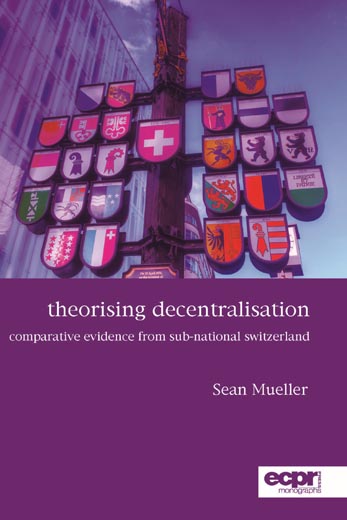
A groundbreaking demonstration of how readily available, reliable data can be used to enrich understandings of the subnational dynamics of governance. Mueller shows that to fully understand the differing degrees, options and supports for decentralisation within federal and decentralised countries – or the different triggers and responses to centralisation imperatives – a stronger focus needs to be given to the combined influences of local and regional culture, policy needs and politics. However, in his new tracking of the relationship between these influences and (de)centralisation outcomes, he not only draws on rich qualitative evidence from Switzerland but lays the ground for more effective and efficient comparative research into these drivers and outcomes across many countries. -- A J Brown, Griffith University
The subtitle of Theorising Decentralisation is an apt choice: indeed, concept, theory, and evidence do come together in this remarkable piece of scholarship. The foundations of the book rest on a within-case comparison, but Theorising Decentralisation is driven by something more than concerns of social science methodology; there are important substantive and theoretical lessons here. National indicators often miss out on regional variation, but there is a lot to be learned from seeking to explain why sub-units behave differently. Sean Mueller targets four Swiss cantons and wants to explain the different levels of centralisation within the country’s subunits. The book brings together ideas from different schools of analysis, and puts this through the filter of various research methodologies. Quantitative indicators and archival evidence together provide the empirical grounding to Mueller’s quest to explain the variation. The result is scholarship in the grand book tradition where big questions are coupled with in-depth case-studies. Not only does one get a theoretically-driven, novel way of conceptualising what (de)centralisation means, one also gets a very interesting glimpse into the politics and history of the Swiss cantons.
-- Jan Erk, University of Leiden
Sean Mueller is a postdoctoral researcher and lecturer at the University of Berne, Switzerland, and editorial assistant of the Swiss Political Science Review. He obtained his PhD from the University of Kent in 2013. Before that, he was Research Fellow at the Institute of Federalism in Fribourg, Switzerland. Since 2011, he has co-convened the Swiss Political Science Association’s standing group on Federalism & Territorial Politics and since 2013, he has been on the editorial board of Fédéralisme-Régionalisme. He co-edited Understanding Federalism & Federation (Ashgate, 2015) and has published in Publius, Government & Opposition, Electoral Studies, Space & Polity and L’Europe en Formation.
The ECPR may receive a commission from the Amazon Services LLC Associates Program or the Google eBooks™ Affiliate Program for qualifying purchases made through the product links on our website.