Menu
Menu

Install this application on your home screen for quick and easy access when you’re on the go.
Just tap then “Add to Home Screen”
By Özge Kemahlioğlu
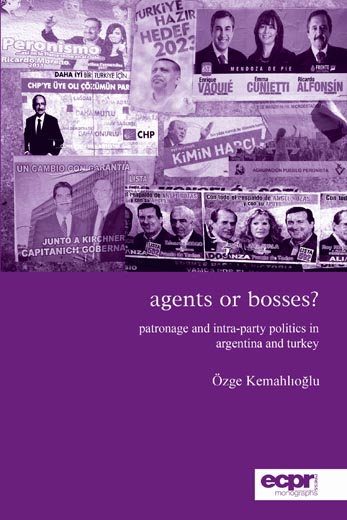
Özge Kemahlioglu's study is a trailblazer moving beyond the partly correct, but woefully incomplete baseline hypothesis that growing economic affluence will erode clientelistic citizen-party linkages. According to her innovative argument, it is the interplay between party leaders and potential challengers inside parties that affects politicians' propensity to dispense patronage. Politicians provide less patronage when competitiveness in the struggle for elected office is all around them; they need their national party leaders' support to survive electoral challenges. But these leaders themselves perceive electoral challenges that make them suspicious of the loyalty of their followers and not supply support, were the latter to build up grassroots patronage networks. Kemahliolu's evidence from Argentinean and Turkish regional and metropolitan politics shows this to be particularly important in an era of economic liberalisation with scarcer patronage resources. The book contributes to the theory of citizen-politician linkage building by focusing on political economy and intra-party organisation. It demonstrates an exemplary research strategy to nest the empirical test of a causal argument with sub-national observations into the geographically, institutionally and culturally very different regime contexts of Argentina and Turkey. -- Herbert Kitschelt, Duke University
This book deserves to be widely read by scholars and students interested in comparative analysis, clientelism and patronage, electoral and party politics, and public policy making at the local and municipal levels. -- Sabri Sayari, Sabanci University
Özge Kemahlioğlu is an assistant professor in the Faculty of Arts and Social Sciences at Sabanci University, Istanbul. Her work focuses on political parties, elections, clientelism, and subnational politics in Latin America and Turkey. She has published articles on parties and clientelism in Comparative Politics, Journal of Politics, and the Journal of Theoretical Politics.
The ECPR may receive a commission from the Amazon Services LLC Associates Program or the Google eBooks™ Affiliate Program for qualifying purchases made through the product links on our website.