Menu
Menu

Install this application on your home screen for quick and easy access when you’re on the go.
Just tap then “Add to Home Screen”
By Jan Biela, Annika Hennl, André Kaiser
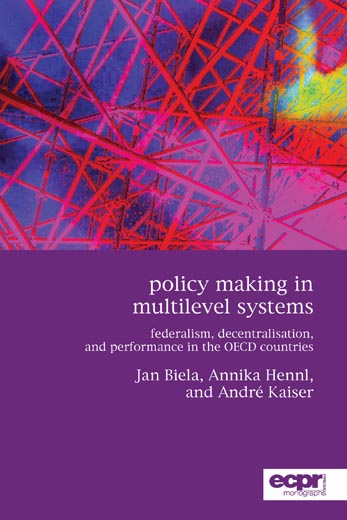
As reformers around the world grapple with ways to improve the effectiveness of public policy, this book offers a timely and insightful comparative analysis of public policy making in four different states. The states are chosen to reflect federal/unitary and centralised/decentralised systems of government, and the authors assess whether these differences in institutional arrangements matter in policy performance in areas such as transport and regional economic development. The authors use an analytical framework that transcends the conventional federal-unitary dichotomy, and draw on both quantitative and qualitative data to show the positive effects of decentralisation on policy performance, rather than federalism per se. The book makes a valuable contribution to our understanding of policy development and the often overlooked question of policy implementation in different institutional settings. There is plenty of stimulating material here for those interested in policy making, implementation, public administration and intergovernmental relations. -- Mark Callanan, Institute of Public Administration
The book represents a theoretically and empirically ambitious attempt to answer the persistent question 'does federalism matter?' Distinguishing between and combining the political-science focus on unitary versus federal modes of policy making and the public-finance focus on centralised versus decentralised modes of policy implementation, the authors seek to identify the impact of different configurations on the policy performance of OECD states. On the basis of a great variety of quantitative cross-sectional and panel analyses and of matched case studies, they show that decentralisation generally has positive effects on policy performance, whereas the effect of federalism tends to be ambiguous or negative. This innovative study is bound to dominate debates in comparative federalism research for years to come. -- Fritz W Scharpf, Max Planck Institute for the Studies of Societies
Does federalism matter for policy performance, and how? This is the key question which Biela, Hennl and Kaiser have sought to answer in their landmark study of Policy-making in Multilevel Systems. Using a mixed-method research design, the authors separate the effects of federal and unitary, from centralised and decentralised multilevel systems, generating a much more nuanced understanding of the virtues and perils of federalism than what is known from previous research. To test for causality they complement their quantitative analysis with qualitative research in two policy areas (regional development and transport policy) in federal and unitary Austria, unitary but decentralsed Denmark, unitary and centralised Ireland and federal and decentralised Switzerland. The authors provide a much more nuanced understanding of the effects of multilevel systems derived from political science and economics, and they demonstrate that by itself there is nothing deterministic in the impact of federalism or decentralisation on policy performance. For students of federalism, decentralisation and public policy analysis this is a must read. -- Wilfried Swenden, University of Edinburgh
Jan Biela is a Doctoral Student and Researcher in the Department of Political Science at the University of Lausanne, Switzerland. He participated in the research project 'Federalism and Decentralization as Dimensions of State Activity' at the University of Cologne and currently works on the democratic legitimacy and accountability of regulatory agencies. His research interests include issues of delegation, regulatory governance, participatory democracy, and comparative federalism. He recently published in Lateinamerika Analysen and Comparative Political Studies.
The ECPR may receive a commission from the Amazon Services LLC Associates Program or the Google eBooks™ Affiliate Program for qualifying purchases made through the product links on our website.