Menu
Menu

Install this application on your home screen for quick and easy access when you’re on the go.
Just tap then “Add to Home Screen”
By Matt Killingsworth
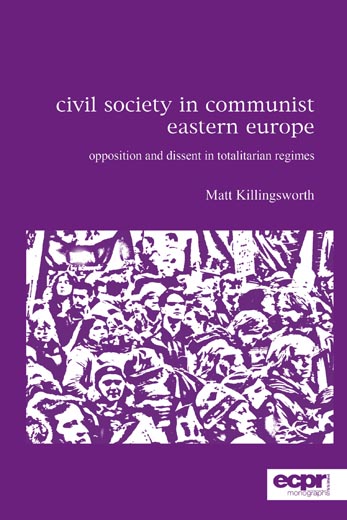
Civil Society in Communist Eastern Europe offers an intriguing critique of the civil society paradigm in the research on former communist countries in Central and Eastern Europe and the revolutions that transformed them. Avoiding popular optimistic assumptions, Matt Killingsworth carefully reviews the theoretical tenets of civil society, drawing on authors as diverse as Hegel, Marx, Gramsci, Habermas, Ernest Gellner and Michael Bernhard. His analysis of the totalitarian condition provides a much needed framework in this field, which will be a reference point in any future discussion. A must-read for scholars who want to critically assess the capacities and limitations of the civil society concept outside the confines of liberal democracies. To them this book offers conceptual clarity and innovation as well as rigorous empirical analysis. -- Helmut K Anheier, Hertie School of Governance
Matt Killingsworth has produced a fine study of opposition under communism. Using the notion of the 'totalitarian public sphere', he shows the role played by opposition forces in Czechoslovakia, the German Democratic Republic, and Poland, and in the process lays bare some of the mechanisms whereby these regimes worked. An insightful and stimulating analysis that should be read by all who are interested in communism and the way it worked. -- Graeme Gill, University of Sydney
In this feisty and original book, Matt Killingsworth argues strongly against the conventional view of civil society’s role in bringing down Communism in Europe, arguing that the concept of a ‘totalitarian public sphere’ better describes developments in the late-Communist era. This book will lead to renewed controversy on what civil society is and what its role – if any – was in late-Communist societies.
-- Leslie Holmes, University of Melbourne
Matt Killingsworth’s exploration of dissent in communist Czechoslovakia, the GDR and Poland offers a fundamental reconceptualisation of the nature of these regimes. His concept of the 'totalitarian public sphere', as a reworking of Habermas’ 'bourgeois public sphere' opens up the debate by offering a more flexible, dynamic image of what totalitarian rule was. Grounded in a detailed study of how dissident groups functioned in this environment it raises important questions about the public/private sphere, public/popular opinion, notions of individual and group identity, and strategies of regime legitimation. This is a major theoretical contribution to the study of communist regimes which highlights inherent limits to state power and the way in which issues of power were contested. -- EA Rees, University of Birmingham
Dr Matt Killingsworth is a lecturer in international relations at the School of Government, University of Tasmania. He has previously held teaching positions at Latrobe University and the University of Melbourne. He has published widely on dissent and opposition in Communist Eastern Europe, transitional justice (lustration) in Czechoslovakia and Poland, and political legitimacy in the Soviet Union and Communist Czechoslovakia and Poland. He is currently researching the relationship between the use of violence, order and justice in the international system.
The ECPR may receive a commission from the Amazon Services LLC Associates Program or the Google eBooks™ Affiliate Program for qualifying purchases made through the product links on our website.