Menu
Menu

Install this application on your home screen for quick and easy access when you’re on the go.
Just tap then “Add to Home Screen”
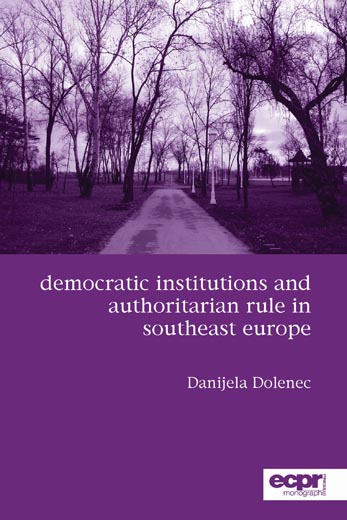
By Danijela Dolenec
Why is Southeast Europe lagging behind? In a broad-based study combining comparative analysis and case studies, Danijela Dolenec explains the rule-of-law conundrum that impedes democratic consolidation in this region. Essential reading for anyone interested in the politics of Southeast Europe and democratisation. -- Frank Schimmelfennig, Center for Comparative and International Studies
Danijela Dolenec's study of democratisation and the rule of law is a major contribution to the study of Southeastern Europe and post-communist democratisation due to its sophisticated methodology, rich empirical research and comparative scope. The book shows convincingly that semi-authoritarian regimes in Serbia and Croatia during the 1990s have a lasting imprint on democratisation in both countries and makes the case, without falling into the trap of historical determinism, that the past matters for democratisation processes. -- Florian Bieber, University of Graz
Danijela Dolenec has written an important, original and well-crafted book to answer the question of why, after two decades of transformation, countries of Southeast Europe remain trapped in low quality, underperforming political systems. She offers a compelling comparative approach and rigorous empirical analysis that identify the rule of law deficit as the main problem. In the best tradition of historical institutionalism she shows persuasively how historical legacies, modes of transition, and patterns of European integration interact to produce powerful path dependent dynamics. This book is admirable in scope, ambition and in methodological self-awareness. It represents comparative research in political science at its best. Democratic Institutions and Authoritarian Rule in Southeast Europe significantly advances our understanding of the post-1989 transformations in Europe and is certainly a must read for all students of comparative politics. -- Grzegorz Ekiert, Harvard University
Danijela Dolenec has written an outstanding, groundbreaking book exploring how states struggle to democratise after authoritarian parties have presided over regime change, colonised the state and exploited the economy. Historical legacies matter - and states that are more authoritarian, more repressive and more criminalised have a tougher time establishing the foundations for liberal democracy, especially a strong rule of law. For scholars of comparative politics, this ambitious book on Southeast Europe is of great value: Dolenec brings theoretical innovation and rigorous empirical analysis to bear on explaining the abiding variation in political outcomes across post-communist Europe after more than two decades of transformation. -- Milada Anna Vachudova, University of North Carolina Chapel Hill
Danijela Dolenec works at the University of Zagreb, teaching comparative politics and social science methodology. She is a critical scholar advocating democratisation, sustainability and resistance to commodification processes. She received her master's degree from LSE (2005), and her doctorate in political science from the ETH Zürich in Switzerland (2012). Her primary interest in post-socialist democratization evolved during her time at Harvard University as a Fulbright scholar (2007/2008). Danijela's previous publications are on topics including the commodification of European systems of higher education and the Europeanisation of post-socialist party systems, and most recently she has co-authored a study on sustainable development in Croatia (We Need to Change, 2012).
The ECPR may receive a commission from the Amazon Services LLC Associates Program or the Google eBooks™ Affiliate Program for qualifying purchases made through the product links on our website.