Menu
Menu

Install this application on your home screen for quick and easy access when you’re on the go.
Just tap then “Add to Home Screen”
By Eleni Panagiotarea
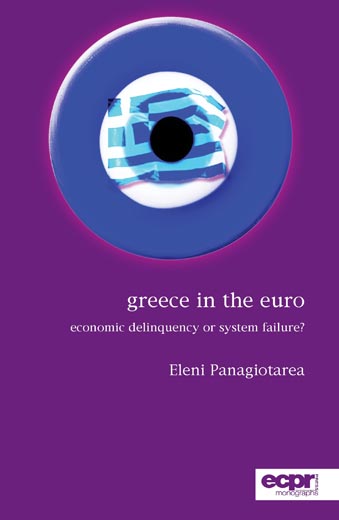
Those who have been puzzled by the unravelling of the political contract that underlay European economic and monetary union will find much of value in this study. Examining the strength of weak institutions, Eleni Panagiotarea shows, through meticulous analysis of the evidence and the use of interviews, how the political commitments involved in the design of monetary union could not be sustained. -- Albert Weale, School of Public Policy
The Europeans have engaged in a protracted and often highly uncivilized blame game as the euro crisis moves from one phase to the next. This book examines the interaction between national and systemic failure, with Greece as a test case. It is lucid, well documented and cogently argued. And it pulls no punches.
-- Loukas Tsoukalis, University of Athens
An informed and balanced account of how Greece and the eurozone got into the mess it’s in. Dr Panagiotarea introduces the reader to the complexities of reforming Greece, and to the shallowness of the ordoliberal design for the euro, challenging easy assumptions about the crisis. The author argues how past weakness of external leverage over domestic reform had implications for the way current adjustment is being managed. Indeed, she highlights key themes and choices for governance, at European and domestic levels, that will resonate for some time.
-- Kevin Featherstone, London School of Economics
Eleni Panagiotarea holds an MPhil and DPhil from the University of Oxford, where she completed a thesis on EMU and National Economic Policy Formation: The Case of Greece. A policy analyst with considerable work and research experience on European political economy and European integration, she has worked in the Greek financial sector and as an advisor for the Ministries of Foreign Affairs and Finance. Her first-hand knowledge of national economic policy-making and her interest in institution building has informed much of her writing on Greece's EMU trajectory, presented in the Greek press and academic journals. She is also a Research Fellow for the Hellenic Foundation for European and Foreign Policy (ELIAMEP), where she is working on issues of economic governance and debt sustainability. Eleni is currently a recipient of an Onassis Public Benefit Foundation research grant, to investigate the effects of the Euro crisis on democratic processes of economic policy formation and implementation.
The ECPR may receive a commission from the Amazon Services LLC Associates Program or the Google eBooks™ Affiliate Program for qualifying purchases made through the product links on our website.