
Menu
Menu

Install this application on your home screen for quick and easy access when you’re on the go.
Just tap then “Add to Home Screen”
Date Tuesday 9 April
Time 17:30
Location A1 in Building D, UCL Mons
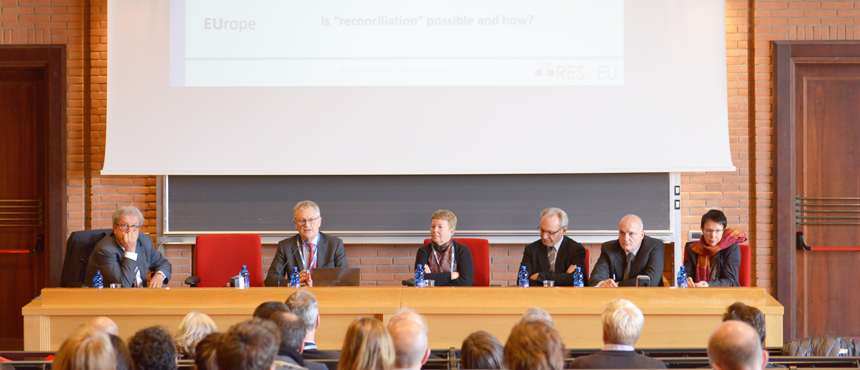
Michel Liégeois, President of the Institute of Political Science Louvain-Europe (ISPOLE) at UCLouvain, will deliver the short welcome address.
Michel Liégeois holds a PhD in Political Science-International Relations from the Université catholique de Louvain where he teaches Theories of International Relations and Security Studies. His research focuses on the various ways of using military tools in support of diplomacy. He has published extensively on international peacekeeping issues. He is currently the President of the Institut de sciences politiques Louvain-Europe (ISPOLE) of UCLouvain and a member of the Scientific Board of the Boutros-Ghali Observatory on peacekeeping operations.
Awarded to Philipp Lutz for his Paper Dynanic Partisan Effects in Migration Policy. Read more about the Rudolf Wildenmann Prize and see a list of past recipients.
 Stein Rokkan Lecture
Donatella della Porta, Scuola Normale Superiore, Florence
The Great Recession that hit the world in 2008 was a critical juncture, nurturing socio-economic but also political transformations. Some of the political developments during the crisis challenged civil, political and social rights, triggering a Great Regression. Social inequalities have spiralled, with growing mistrust in established institutions triggering a sense of insecurity, and calls for exclusion. The Great Recession had immediate and often dramatic political effects – especially on representative institutions. Party systems were particularly shaken, with the breakdown of mainstream parties and, in some cases, an unexpected rise of movement parties on the Left, and right‑wing populist ones.
Direct forms of democracy and participatory innovations were fuelled by a growing malaise towards representative institutions. The crisis of institutional trust prompted calls for constitutional reforms that could help re-found the political community.
In sum, while political science research had pointed at the freezing of the traditional cleavages, the Great Recession brought about a de-freezing of all four lines of conflict that Stein Rokkan had analysed, as well as the emergence of new ones.
With reference to these transformations in social and political conflicts, the lecture will first address the political crises that were triggered by socio-economic transformations.
In the second part of the lecture, the reflection will move to the challenge that sudden changes present to the existing analytical toolkit for the study of democracies.
Addressing mainly periods of stability, empirical theories of democracy have in fact traditionally studied institutional conditions for democratic governance. Constitutions have anchored functional and geographical divisions of power and citizenship rights within nation states; political parties have been considered as the most important bi‑frontal institutions in bridging the state and civic society; institutions of direct democracy have been considered as ways to complement delegation with some participation in specific (often limited) forms.
Empirical theories of democracy tended to stress continuities, looking at ways in which institutions structure behaviours, cleavages are frozen, political socialisation reproduces (or not) democratic values. Not only constitutions, but also public policies have been considered as establishing path-dependent reproduction or, at best, gradual, incremental adaptation.
Recent evolutions have prompted instead an acceleration of constitutional processes, the emergence of new parties, and the multiplication of referendums. Times of multiple crises and sudden changes are under-structured times, in the sense that structures are no longer able to constrain events.
The concept of critical juncture, while quite stretched to cover a heterogeneous range of phenomena, will be revisited as a useful tool in understanding intense moments, such as the one we are living through, in which transformations happen quickly and in a cumulative fashion, as agency and conjectural developments seem able to break existing structures.