
Menu
Menu

Install this application on your home screen for quick and easy access when you’re on the go.
Just tap then “Add to Home Screen”
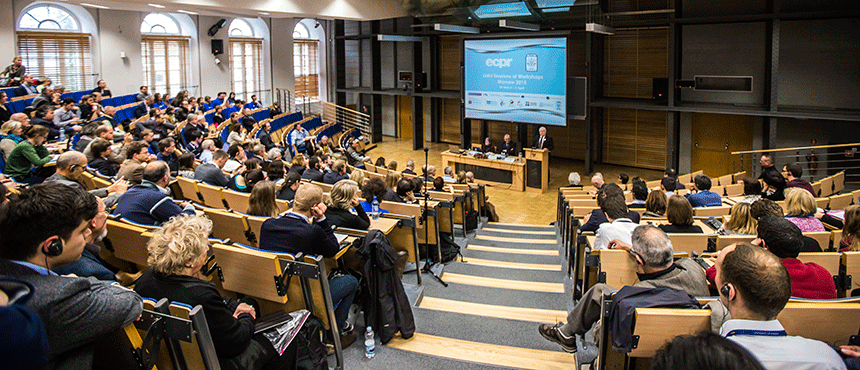 Welcome Address, Prize Giving and Stein Rokkan Lecture
Date Tuesday 26 April
Time 1715-1845
Location Aula Magna, Polo Carmignani, University of Pisa
By Donatella Della Porta
 Donatella is a Professor of political science and Dean of the Institute for Humanities and the Social Sciences at the Scuola Normale Superiore in Florence, where she is also Director of the Center on Social Movement Studies (Cosmos). She is now working, having been awarded a major ERC Advance Scholars' grant, on "Mobilizing for Democracy", looking at civil society participation in democratization processes in Europe, the Middle East, Asia and Latin America. She has written almost 80 books, translated into several languages, on social movements, political participation, corruption, public order and political parties. In 2011, she was the recipient of of the Mattei Dogan Prize for distinguished achievements in the field of political sociology. Donatella holds honourary PhDs from the universities of Lausanne, Bucharest and Goteborg.
The 2015 Jean Blondel PhD Prize for the best thesis in politics will be awarded to Jovana Mihajlovic Trbovc (University of Ljubljana and Peace Institute Ljubljana) for her thesis: ‘Public Narratives of the Past in the Framework of Transitional Justice Processes: The Case of Bosnia and Herzegovina’. To read more about Dr Mihajlovic Trbovc's thesis, the Blondel Prize and past recipients, see the Prizes pages.
The 2015 Wildenmann Prize will be awarded to Carina Schmitt from the University of Bremen. Dr Schmitt for her paper ‘The Legacy of Colonialism: The Origins of Social Security in Developing Countries’ that she presented at the 2015 Joint Sessions of Workshops in Warsaw. To read more about Dr Schmitt's Paper, the Wildenmann Prize and past recipients, see the Prizes pages.
By Maurizio Ferrera, Università degli Studi di Milano
Heading for Collision? Economic and Social Europe in Search of Reconciliation

Writing in the 1960s and early 1970s, Stein Rokkan remained quite skeptic about the prospects for European integration. In his view, the EEC was essentially a form of cooperation between administrative and corporate agencies, and could not create effective cross-system structures nor a ‘genuine community of trust’ among the peoples of Europe. To a large extent, Rokkan’s skepticism proved wrong. The EU has gone a long way in redesigning (weakening, differentiating, in some cases dismantling) systemic boundaries, not only in the economic but also in the social sphere. It has also acquired a number of significant ‘statist’ features: a supranational bureaucracy, an independent judiciary, common (quasi) representative and executive institutions. But the genuine community of trust has not come about. The crisis has in fact dissipated a significant share of that ‘communal’ capital which had been laboriously accumulated since the 1990s, especially within the so called Eurozone. Two new and foreboding lines of conflict have emerged, both rooted in the tension between the ‘economic’ and ‘social’ dimensions of integration: a North-South conflict, pitting the creditor countries of the EMU core against the debtors of the Southern periphery; and an East-West conflict, pitting high-wage-high-welfare Member states against their low-wage-low-welfare counterparts in Central and Eastern Europe. Will the EU be up to the daunting task of managing such conflicts and contain their disgregative implications? Is it possible (and how) to reconcile Economic and Social Europe, thus creating the potential for genuine community-building?
The lecture will propose a ‘post-Rokkanian’ diagnosis of the current EU predicament and will try to identify some possible ways out, as well as their political and institutional preconditions.
Maurizio Ferrera is a professor of political science at the University of Milan and President of the Network for the Advancement of Social and Political Sciences (NASP) among eight Northern Italian Universities. He has been Visiting Professor in several foreign universities, including the EUI, UC-Berkely, Mc-Gill and the LSE. Between 2003 and 2009 he served as Member of the Executive Committee of the ECPR. Maurizio Ferrera’ research concentrates on comparative welfare states (with a specific focus on Southern Europe) and European Integration. In many of his works, he has re-elaborated the ‘Rokkan-Hirschman model’ to investigate the impact of integration on national systems of social protection. In 2014 he received an ERC advanced grant for a broad research project on ‘Reconciling Economic and Social Europe: the role of ideas, values and politics’ (www.resceu.eu). His main book in English is The Boundaries of Welfare. The New Spatial Politics of Social Protection (Oxford University Press, 2005; translated into French in 2009). His latest Journal articles include Solidarity in Europe after the Crisis (Constellations, 21/ 2, 2014) and Ideology, Parties and Social Politics (West European Politics, 37/ 2, 2014). In Italian he has recently published Rotta di Collisione: euro contro welfare? (Laterza, 2016).