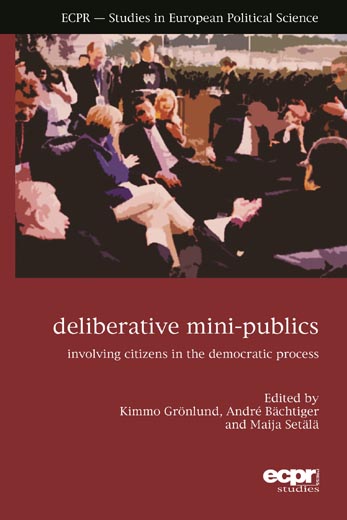
The first comprehensive account of the booming phenomenon of deliberative mini-publics, this book offers a systematic review of their variety, discusses their weaknesses, and recommends ways to make them a viable component of democracy.
The book takes stock of the diverse practices of deliberative mini-publics and, more concretely, looks at preconditions, processes, and outcomes. It provides a critical assessment of the experience with mini-publics; in particular their lack of policy impact.
Bringing together leading scholars in the field, notably James S Fishkin and Mark E Warren, Deliberative Mini-Publics will speak to anyone with an interest in democracy and democratic innovations.
Deliberative Mini-Publics offers a multifaceted exploration — at once normative, empirical and practical — of a growing family of institutional innovations that aim to deepen democracy by fostering citizen participation and deliberation that is fair, wise, and inclusive. This volume comes at an urgent moment when many peoples are losing faith in the central institutions that constitute representative democracy — from elections to political parties to the state itself. It offers a science and philosophy to begin to rebuild that faith by reinventing the institutions of democratic engagement. -- Archon Fung, Harvard Kennedy School
Mini-publics are an important and exciting innovation in our democratic repertoire. Bächtiger, Grönlund and Setälä have brought together some of the very best scholars working on this subject and produced an outstanding volume that showcases the most up-to-date thinking and the latest research ? both empirical and theoretical ? on mini-publics. A must-read book for anyone interested in deliberative democracy and citizen participation. -- Simone Chambers, University of Toronto
Those committed to a deliberative conception of democracy are notable for seeking to see how deliberative theory can be implemented through mini-publics. This strength of deliberative theoretical work can make it hard for the interested reader to follow developments, since there is a wealth of invention and innovation. This invaluable volume provides just what is needed. The contributions bring the reader up to date with developments in theory and practice, and open up new lines of theoretical and empirical enquiry, particularly in relation to the ways mini-publics fall short of requirements of political equality, the understanding of mini-publics in terms of experimental design, and the role of facilitation in deliberative events. -- Albert Weale, University College London
This edition on deliberative mini-publics combines in a very innovative way conceptual and empirical research. It takes into account that the question is no longer ‘whether deliberative mini-publics work’, but examines the outcomes and impacts of different concepts, designs and processes. Consequently it is a great starting point for answering the question whether and how deliberative mini-publics can enhance the quality of democracy. It pools all important players in the field, providing a comprehensive overview of the current state of the art and is indispensable for anybody interested in developments towards more deliberative forms of democracy. -- Brigitte Geißel, Goethe University
André Bächtiger is currently Research Professor of the Swiss National Science Foundation at the University of Lucerne's Institute of Political Science. His research focuses on the challenges of mapping and measuring deliberation as well as understanding the preconditions and outcomes of high-quality deliberation in the context of representative institutions and of mini-publics.
Kimmo Grönlund is professor of political science at Åbo Akademi and director of the Social Science Research Institute (Samforsk). He is Deputy Director of the Centre of Excellence, Democracy – A Citizen Perspective (D:CE). His main research interests are participatory democracy, deliberative democracy, political knowledge, political behaviour, public opinion and elections. His current research projects include: Deliberation Within and Across Enclaves (2011–2015), funded by the Academy of Finland, and Democracy: A Citizen Perspective (2006–2014), funded by Åbo Akademi Foundation.
Maija Setälä is Professor of Political Science at the University of Turku. She specialises in democratic theory, political trust, direct democracy and democratic innovation and has published a number of articles and books on these topics. Recently, Setälä has applied experimental methods in collaboration with a group of researchers organising field experiments on citizen deliberation.
Didier Caluwaerts is a professor of political science at the Vrije Universiteit Brussel. His book Confrontation and Communication: Deliberative Democracy in Divided Belgium (2012 Peter Lang) has won the 2013 ECPR Jean Blondel award. He has published in Acta Politica, Ethnopolitics, Politics, Res Publica, European Political Science Review, Government & Opposition, Journal of Elections, Public Opinion & Parties, Religion, State & Society, Journal of Public Deliberation, and West European Politics.
Aubin Calvert holds a PhD in Political Science from the University of British Columbia. Her major research interests include democratic theory and political communication. In particular, her work has focused on the nature, effects and implications of strategic uses of language in democratic politics. Her dissertation also identifies new ways in which democratic institutions might promote good political judgements, despite the fact that the ways people use language in politics are almost always strategic.
James S Fishkin holds the Janet M Peck Chair in International Communication at Stanford University, where he is Professor of Communication and Professor of Political Science. He is also Director of Stanford’s Center for Deliberative Democracy and Chair of the Department of Communication. He is the author of a number of books including Democracy and Deliberation: New directions for democratic reform (1991), The Dialogue of Justice (1992), The Voice of the People: Public opinion and democracy (1995), Deliberation Day (2004, with Bruce Ackerman) and When the People Speak: Deliberative democracy and public consultation (2009).
Marlène Gerber holds a PhD in political science from the University of Bern, Switzerland. Currently, she is Assistant Director of the Année Politique Suisse, the Annual Yearbook of Swiss Politics, located at the Institute of Political Science, University of Bern. Her principal research interests include deliberation, political communication and political participation.
Kaisa Herne is a Professor of Political Science at the University of Tampere. Her research focuses on questions of justice and fairness, the notion of impartiality, deliberative democracy and voting rules. She uses the experimental method widely in her research. Her articles have been published in Inquiry, Political Behavior and Political Studies, among others.
Dimokritos Kavadias is an Assistant Professor in the Political Science department of the Free University of Brussels. He also teaches in the social work department at the University of Antwerp. His teaching is mainly on methodology courses. His research interests include social work research, educational sociology, educational policy, political psychology, civic education, political socialisation and political behaviour.
Claudia Landwehr is a Schumpeter Fellow at the Institute of Political Science at the Goethe-University Frankfurt / Main. She has previously been a junior research fellow at the University of Hamburg and an academic visitor at the Australian National University and Harvard University. Her research focuses on theories of democracy and justice and, more recently, on the distribution of healthcare in international comparison. She has published on deliberative democracy, communicative interaction and health care rationing.
Michael E Morrell is an Associate Professor of Political Science at the University of Connecticut. He is working on various projects related to deliberation, emotions in politics and political participation, including research on the New England Town Meeting in Connecticut and the Oregon Citizens’ Initiative Review. Trained as a political theorist who appreciates grounded research, he seeks to bridge the gap between normative theory and empirical political science. He is the author of Empathy and Democracy: Feeling, thinking and deliberation (Penn State University Press, 2010), which was recently released in paperback. His research has also appeared in journals such as Political Research Quarterly, Political Behavior, Public Opinion Quarterly and Public Affairs Quarterly.
Simon Niemeyer is Professor and co-founder of the Centre for Deliberative Democracy and Global Governance at University of Canberra. His research covers the broad field of deliberative democracy, with a focus on the use of empirical research to inform its theoretical foundations and understand how they translate into practical democratic innovations.
Ian O'Flynn is Senior Lecturer in Political Theory in the School of Geography, Politics and Sociology, Newcastle University, UK. He has held visiting positions at Harvard University, the University of Pennsylvania and the Australian National University. His main research interest is in exploring the implications of deliberative democracy for multicultural and multinational societies. He is the author of Deliberative Democracy and Divided Societies (2006) and his articles have appeared in journals such as the British Journal of Political Science, Government and Opposition, Political Studies and Politics, Philosophy and Economics. Ian is currently a member of the ECPR Press editorial team.
Graham Smith is Professor of Politics at the Centre for the Study of Democracy, University of Westminster and Chair of the Knowledge Network on Climate Assemblies (KNOCA). He is a specialist in democratic theory and practice. His publications include Democratic Innovations: Designing Institutions for Citizen Participation (Cambridge, 2009), Can Democracy Safeguard the Future? (Polity, 2021) and Democracy in a Pandemic: Participation in Response to Crisis (University of Westminster Press, 2021).
Gaurav Sood is a National Fellow at the Hoover Institution at Stanford University. Gaurav is currently exploring antecedents and consequences of group-based affect, focusing mainly on political groups. In previous work on the topic, he found that in the US, in recent times, many of those who identify with a political party hold negative stereotypes about supporters of the main opposing party. In his recent work, he has explored the impact of group-based affect (and reasoning) on ideological accountability. He finds that elites of the respondent’s own party are only modestly penalised for taking extreme positions. His other research interests include exploring how people learn from data and documenting biases in the data accessible to people.
Kim Strandberg holds a PhD in Political Science and is a Senior Researcher and Adjunct Professor in the Social Science Research Institute at the Department of Politics and Administration of Åbo Akademi University (Finland). His primary areas of research are political communication, citizen deliberation and political uses of the internet. He has published on these topics in journals such as Party Politics, New Media & Society, Information Polity, Scandinavian Political Studies and the Journal of Information Technology and Politics.
Mark E Warren holds the Harold and Dorrie Merilees Chair for the Study of Democracy at the University of British Columbia. He is especially interested in democratic innovations, civil society and democratic governance, and political corruption. Warren is author of Democracy and Association (Princeton University Press), editor of Democracy and Trust (Cambridge University Press) and co-editor of Designing Deliberative Democracy: The British Columbia Citizens’ Assembly (Cambridge University Press 2008). His work has appeared in journals such as the American Political Science Review, American Journal of Political Science and Political Theory. He is currently working with an international team on a project called Participedia, which uses a web-based platform to document democratic innovations around the world.