Menu
Menu

Install this application on your home screen for quick and easy access when you’re on the go.
Just tap then “Add to Home Screen”
By Richard Bellamy, Dario Castiglione
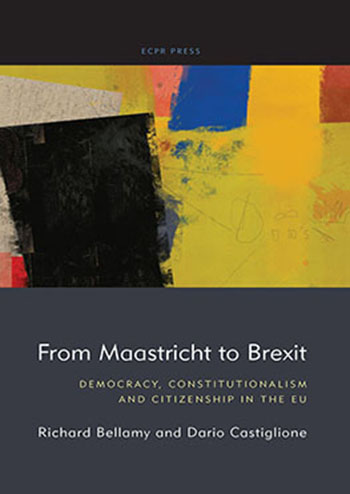
Richard Bellamy and Dario Castiglione have authored - together, alone and with others - many essays on European democracy which they now assemble in a rich compilation prefaced by a new essay spanning from Maastricht to Brexit. The challenges that interconnectedness poses to legitimate governance in Europe, at both national and EU level, are addressed from a republican view of politics which puts a premium on freedom as non-domination. Between the contraposed solutions offered by cosmopolitanism and communitarianism that propose, respectively, a leap forward into global governance and a retrenchment into national self-determination, Bellamy and Castiglione advance "cosmopolitan communitarianism" as a normative position that holds together a sense of responsibility vis-à-vis the citizens of other national communities and a sense of ownership of the decisions made on behalf of one's national community in a context of interdependency. It is in the balance between a new and more complex notion of sovereignty and multilevel inter-institutional checks that the idea of the republican mixed government which "removes arbitrary power from any single agent or agency" can be resurrected to yield the solution for legitimate governance in the contemporary EU. A highly readable and remarkably coherent set of essays that contribute sometimes in a conclusive manner to the many normative debates that have characterized European Union studies. -- Simona Piattoni, University of Trento
This book has the potential to make people think afresh about the EU. Rather than trying to persuade the reader with familiar arguments of either Eurosceptics or Euroenthusiasts, the authors conceive of the EU as a paradigmatic case for “taking back control” in an interconnected world by a kind of international governance between democratic states and their peoples―democracy. -- Ulrich K. Preuß, Hertie School of Governance
Dario Castiglione and Richard Bellamy have managed to cover all important challenges of the current state of the European Union. Their tightly composed volume is a lucid and transparent exercise in what I would call constitutional sociology of the European Union. Legitimacy of both the "polity" and "regime" of the EU are the key reference problems. After the silent majority of compliant Europeans has been displaced by the noisy minority of populists, the gap between them and the ruling EU technocracy must be filled by a politics of building supranational democracy. The book makes us understand the magnitude of this challenge. -- Claus Offe, Hertie School of Governance
The two authors are the Gold Standard when it comes to this topic. -- Glyn Morgan, Syracuse University
Richard Bellamy is Professor of Political Science and Director of the European Institute, University College London. In 2012 he was awarded the British Academy's Serena Medal 'for eminent services towards the furtherance of the study of Italian history, literature, art or economics'.
His Italian publications include Modern Italian Social Theory (Polity Press and Stanford, 1987) and (with Darrow Schecter) Gramsci and the Italian State (Manchester University Press, 1993) along with critical editions of Beccaria, Gramsci and Bobbio.
The ECPR may receive a commission from the Amazon Services LLC Associates Program or the Google eBooks™ Affiliate Program for qualifying purchases made through the product links on our website.