Menu
Menu

Install this application on your home screen for quick and easy access when you’re on the go.
Just tap then “Add to Home Screen”
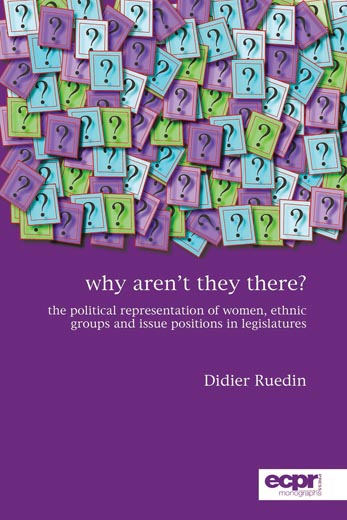
By Didier Ruedin
An excellent piece of work that jointly discusses two dimensions and two groups that have been studied too often apart from one another: descriptive and substantive representation, and women and ethnic groups. It uses new and rich data, the hypotheses are well embedded in the existing theories and empirical research, and the research design and methods are intelligent. Well written and comprehensive, this is a must-read for scholars interested in representation and representativeness of today’s legislatures. -- Karen Celis, Vrije Universiteit Brussel
Ruedin adds to our understanding of political representation with an impressive comparative study of the gender and ethnic composition of national legislatures, two largely separate research fields; the representation of women and of ethnic groups. Alongside this he assembles relevant material from literature on parties, electoral studies, feminist research and political theory, using it to develop a single integrated theoretical framework and hypotheses which he tests on multiple data sources, including new data and the World Values Survey.' Why aren’t they there? is a comprehensive and significant addition to the literature on this topic and should be compulsory reading for all students of political representation. -- Rosie Campbell, University of London
This is a careful and thorough study that explores the representation of groups and the representation of ideas is a benchmark for future research in this field. Ruedin examines the descriptive representation of women, ethnic groups and substantive representation in general, using a large-N comparative approach. The exploration of empirical theories of representation with such a varied set of focii is impressive, and a necessary step if we are to accept theories evolved in one area that are claimed to be of more general application.
Ruedin's results are something of a challenge to the orthodoxy of institutionalism since he finds mechanisms like quotas and even electoral systems have relatively weak effects, while various measures of, and proxies for, cultural variations appear to have more impact. While this book will not be the last word on these topics, Ruedin's work cannot be ignored by anyone working on this topic in the future. -- Michael Marsh, Trinity College Dublin
Didier Ruedin (DPhil, Oxford) is a researcher at the Swiss Forum for Migration and Population Studies, University of Neuchâtel, Switzerland. He works on various aspects of political representation, including the political representation of women and ethnic groups in national legislatures. His 2009 article on the political representation of ethnic groups in a cross-national perspective won the SNIS International Geneva Award 2010. In 2012, Ruedin was a visiting fellow at the University of Vienna. Other areas of research include the politicisation of immigration, and attitudes toward foreigners.
The ECPR may receive a commission from the Amazon Services LLC Associates Program or the Google eBooks™ Affiliate Program for qualifying purchases made through the product links on our website.