ECPR

Install the app

Install this application on your home screen for quick and easy access when you’re on the go.

Just tap Share then “Add to Home Screen”

ISBN:
9781907301186 9781785520808
Type:
Paperback
ePub
Publication Date: 1 August 2011
Page Extent: 252
Series: Monographs
Buy Paperback from AmazonBuy EPUB from Google

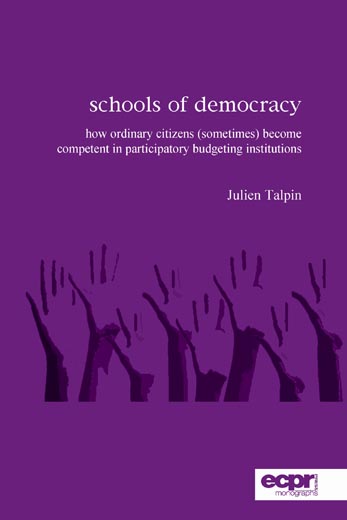
Schools of Democracy

How Ordinary Citizens (Sometimes) Become Competent in Participatory Budgeting Institutions

By Julien Talpin

Schools of Democracy offers a vivid analysis of the long-term impact of engagement in participatory budgeting institutions in Europe. While democratic innovations flourish around the world, there have been great hopes for their potential to revitalize representative government and solve the increasing apathy of the public.

Based on a rich ethnographic study in France, Italy and Spain, this book shows how participatory institutions can encourage personal involvement, by creating the procedural and social conditions conducive to the formation of a competent and involved citizenry.

Rather than deliberation itself, it seems that informal discussions and interactions between a diverse public allow mutual learning and the beginning of a political trajectory for people at the margins of the public sphere.

However, this book also shows that citizens can become disappointed by the little decision-making power they are granted, as they leave the process often more cynical than before.

Contains:

A unique study on the long-term individual impact of engagement in participatory institutions. While most research deal with short-term impact, Schools of democracy addresses impact of participation after two years of engagement.

Unique access to the black box of participatory institutions. While research on democratic innovations generally opt for an externalist perspective, Schools of democracy details the routine of deliberative interactions, showing how ordinary citizens speak up in public assemblies. From this perspective, the book offers incredibly rich empirical material – coming from ethnographic research – on how participatory democracy works.

An original theoretical framework to the study of the individual impacts of participatory engagement. While most research are based on an implicit rational choice perspective, the pragmatist perspective adopted here sheds a different light on the studied phenomenon, stressing the co-construction of actors and their environment.

The book is important and innovative for several reasons... 'Schools of Democracy' is a book that anyone interested in the recent debates about democracy must definitively read. -- Joan Font Fàbregas, 'Revista Internacional de Sociología'

Julien Talpin is a research fellow at the French National Scientific Research Center (CNRS), professor of politics at the University of Lille 2. His research deals with the study of deliberative democracy from below, aiming at understanding how participatory experiences are lived by actors and shape their political and personal careers. He is currently investigating the conditions of inclusion of poor people and minorities in participatory processes in Europe and the US. He is co-editor of the French-speaking journal Participations. He has recently published Schools of Democracy: How Ordinary Citizens (Sometimes) Become Competent in Participatory Budgeting Institutions, Colchester, ECPR Press, 2011; ‘What can ethnography bring to the study of deliberative democracy? Evidence from the study on the impact of participation on actors’, Revista International de Sociologia, 70 (2), 2012; ‘When deliberation happens. Evaluating discursive interactions among ordinary citizens’, in B. Geißel, M. Joas, (eds.) Participatory Democratic Innovations in Europe: Improving the Quality of Democracy? Berlin/Toronto, Burdeish Publishers, 2013.

The ECPR may receive a commission from the Amazon Services LLC Associates Program or the Google eBooks™ Affiliate Program for qualifying purchases made through the product links on our website.