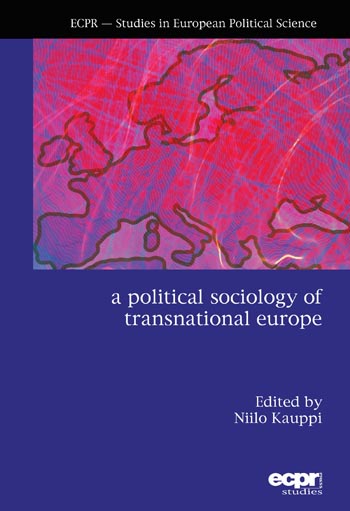
Globalisation and complex Europeanisation are two significant challenges currently influencing the restructure of the European nation-state, and redefining political power.
For this volume, first-rate European scholars look at the consequences of these and other challenges faced by European societies.
Contributions revisit traditional objects of political science – state sovereignty, civil society and citizenship – mixing sophisticated empirical analyses with methodological and conceptual innovations including field theory, multiple correspondence analysis, and the study of space sets.
Combining qualitative and quantitative research techniques, and macro- and micro-levels, chapters have in common a contextual analysis of politics through scrutiny of configurations of groups, representations and perceptions.
A transnational perspective is the common thread linking every study in this volume, which seeks to avoid methodological nationalism.
Didier Bigo is Professor at King’s College London, Department of War Studies (part time) and Research Professor of international relations (maître de conférences des universités) at Sciences-Po Paris, CERI/FNSP. He is Director of the Center for the Study of Conflicts (Centre d’études sur les conflits) and editor of the quarterly journal Cultures & Conflits published by l’Harmattan. He is founder and former co-editor, with Rob Walker, of the International Studies Association journal International Political Sociology, published by Blackwell. He works on critical approaches to security in Europe and the relationship between internal and external security, as well as on the sociology of policing and surveillance. He analyses the relationships and tensions between international relations, politics and sociology. Bigo has been responsible for the WP1 of the FP7 'INEX' research programme on internal and external security and has been the scientific coordinator of the FP6 'Challenge' research programme.
Philippe Blanchard is Senior Researcher at the IEPI, University of Lausanne. He works on political sociology, political communication, and methods for social and political sciences: sequence analysis, content analysis, questionnaire surveys, interviewing, correspondence analysis and other descriptive multivariate statistics. He is presently conducting research on political biographies: AIDS activists in France, party members in Morocco, Swiss trade unionists, and European corporate elites. His current research projects also include the socioeconomic roots of parliamentary voting in Switzerland and the public controversy about nuclear energy in France. He is currently preparing a book on sequence analysis, to be published by Palgrave Macmillan and the ECPR.
Donatella della Porta is Professor of Political Science at the Istituto Italiano di Scienze Umane (on leave of absence) and Professor of Sociology in the Department of Political and Social Sciences at the European University Institute. In 2011, she was awarded the Mattei Dogan Prize for distinguished achievements in the field of political sociology. Her main fields of research are social movements, the policing of public order, participatory democracy, and political corruption. Among her very recent publications are: Mobilizing for Democracy. Comparing 1989 and 2011 (Oxford University Press 2014); Can Democracy be Saved? (Polity Press 2013); Blackwell Encyclopaedia of Social and Political Movements (edited with D. Snow, B. Klandermans, and D. McAdam, Blackwell 2013); Clandestine Political Violence (Cambridge University Press 2013); Mobilizing on the Extreme Right (with M. Caiani and C. Wagemann, Oxford University Press 2012); Meeting Democracy (co-edited with D. Rucht, Cambridge University Press 2012).
Tero Erkkilä is University Lecturer of political science at the Department of Political and Economic Studies, University of Helsinki. His research interests include transnational governance, public institutions and collective identities. He has published on accountability, transparency, public information management, governance indices, higher education rankings and EU concepts. His recent publications include 'The making of a global field of higher education: actors, institutions and practices' (with N. Kauppi) in International Political Sociology (2011) and 'Alternatives to Existing International Rankings' (with N. Kauppi) in UNESCO World Social Science Report (2010). His book Government Transparency: Impacts and Unintended Consequences is forthcoming by Palgrave. Erkkilä directs 'Transnational Governance of Higher Education', a research project funded by the University of Helsinki Network for Higher Education and Innovation Research (HEINE).
Olivier Fillieule is Professor in political sociology and member of the CRAPUL Research Center on Political Action at the University of Lausanne. He is also Research Professor at CNRS, Paris I Sorbonne (on leave). His work focuses on social movement and political activism, anti HIV/AIDS and global movements. He has recently published (with D. Tartakowsky) La manifestation (Presses de Sciences Po 2012) and co-edited (with E. Agrikoliansky and I. Sommier) Penser les mouvements sociaux: Conflits sociaux et contestations dans les sociétés contemporaines (La Découverte 2010), (with L. Mathieu and C. Péchu) Dictionnaire des mouvements sociaux (Presses de Sciences Po 2009), (with P. Roux) Le sexe du militantisme (Presses de Sciences Po 2008), (with E. Agrikoliansky and I. Sommier) Généalogie du mouvement altermondialiste en Europe (Karthala 2008), (with P. Favre and F. Jobard) L’atelier du politiste (La Découverte 2007) and (with D. Della Porta) Police et manifestants. Maintien de l’ordre et gestion des conflits (Presses de Sciences Po 2006).
Daniel Gaxie is a political sociologist and Professor of political science at the University of Paris 1 Panthéon-Sorbonne. He has conducted extensive research on political participation, attitudes and behaviour, elites, institutions and public policies. As well as his involvement in the INTUNE and Eurelites projects he is known for his book Le cens caché (The Hidden Disfranchisement) first published in 1978.
Nicolas Hubé is Assistant Professor of Political Science and Deputy-Dean of the Political Science Department at the University of Paris 1 Panthéon-Sorbonne. As well as his involvement in the INTUNE project, his research interests include the use and misuse of polls in political life and communication in EU institutions. He has published in Perspectives on European Politics and Society.
Theresa Kuhn is a Post-doctoral Research Fellow at the Department of Politics and International Relations, University of Oxford. She is also a member of Nuffield College. In 2011, she obtained a PhD from the European University Institute. Currently, she is working on a book project entitled Experiencing European Integration: The effect of individual transnationalism on European identity. Her research interests are at the intersection of political sociology, European studies and comparative politics, and focus on collective identities, democratic legitimacy, transnationalism, cosmopolitanism, solidarity and border regions. Her work has appeared in the European Journal of Political Research and European Union Politics.
Mikael Rask Madsen is Professor of European law and integration, focusing on international law, courts and society, and Director of iCourts, the Danish National Research Foundation’s Centre of Excellence for International Courts, Faculty of Law, University of Copenhagen. Trained in both law and sociology, his research concerns the globalisation of law and the creation of transnational legal fields with a particular focus on the interface of agents, typically legal agents, and the emergence of institutions and law.
Hélène Michel is Professor of political science at Sciences Po Strasbourg where she teaches the sociology of the European Union and European public policies. A member of the Institut Universitaire de France, her research deals with European interest groups, especially with the sociology of lobbyists and the analyses of their practices. She has published La cause des propriétaires (PUF 2006) which is an historical and sociological analysis of the evolution of housing policy and landowner and real estate agent lobbies, and she has edited Lobbyistes et lobbying de l’Union européenne (PUS 2005) and La fabrique des ‘Européens’: Processus de socialisation et intégration européenne (PUS 2010). She conducted a large quantitative and qualitative research project PRESSURE on the representatives of European interest groups. Currently she is interested in the litigation strategies of interest groups and their political uses of European law and rights ('The Construction of a European Interest through Legal Expertise: Property Owners’ Associations and the Charter of Fundamental Rights', in J. Rowell and M. Mangenot (eds), The Political Sociology of the European Union: Reassessing constructivism, Manchester 2010).
Louisa Parks completed her PhD, a comparative study of the impacts of social movement campaigns in the European Union, in 2009 at the European University Institute in Florence. She is currently mapping recent social movements in Italy, as well as working as an editor and academic translator.
Ettore Recchi is Professor of political sociology in the University of Chieti-Pescara, Italy. He holds a PhD (with distinction) in Social and Political Sciences from the European University Institute. His main research foci are migration and mobility (in its different forms), social stratification, elites, and European integration. Currently he coordinates two international projects funded by the European Commission – EUCROSS (www.eucross.eu) and MOVEACT (www.moveact.eu) – on the 'Europeanisation of everyday life' and the 'Political behaviour of European mobile citizens'. Among his recent publications are 'Social Mobility and Spatial Mobility' (with A. Favell), in A. Favell and V. Guiraudon (eds), Sociology of the European Union (Palgrave 2011), 'Crossing Over, Heading West and South: Mobility, Citizenship, and Employment in the Enlarged Europe' (with A. Triandafyllidou), in G. Menz and A. Caviedes (eds), Labour Migration in Europe (Palgrave 2010) and Pioneers of European Integration: Citizenship and mobility in the EU (co-editor with A. Favell) (Elgar 2009).
Stefan Seidendorf is Researcher in political and social sciences at the Franco-German Institute (DFI) in Ludwigsburg, Germany, where he heads the European Politics department. His PhD thesis (Europäisierung nationaler Identitätsdiskurse? Ein Vergleich französischer und deutscher Printmedien, Nomos, 2007) analyses the 'Europeanisation' of French and German identity discourses (1950–2000). Other major publications concern the use of history in European politics and the constitutive role of discourses in national debates on Europe.
Jonathan White is Reader in European politics at the London School of Economics and Political Science. His research interests lie in the fields of political sociology and political theory, with a focus on contemporary European democracy and the European Union. Prior to joining the LSE, he was an Alexander von Humboldt Research Fellow at the Humboldt University in Berlin, and a doctoral researcher at the European University Institute in Florence. His publications include articles in American Political Science Review, Journal of Politics, Political Studies, British Journal of Political Science, and Journal of Common Market Studies. He is the author of Political Allegiance after European Integration (Palgrave 2011).